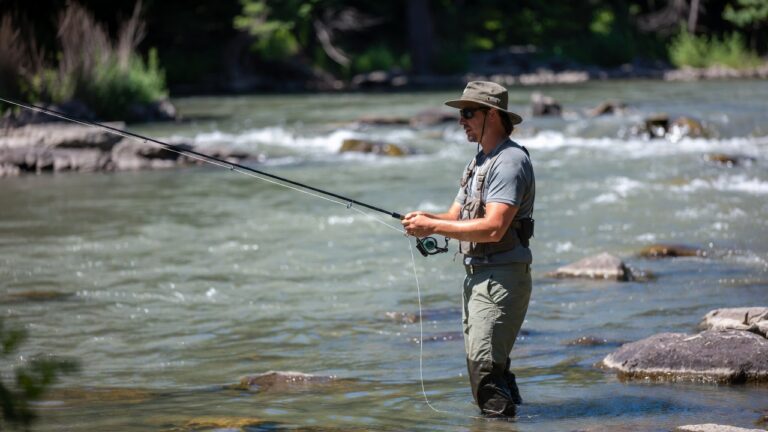
Fishing Tips for Beginners
Are you finally ready to drop anchor in that serene lake down the road?

Last updated: November 6, 2026 · Originally published October 10, 2017
Here are some of our favorite tips for all prospective fishermen to consider before they throw their lines.
Research and Study

If you like the outdoors, the last thing you might want to do is read a book. But amateur fishermen need to have a fair idea of what they are getting themselves into and what will be required of them. There are a great number of wonderful books on fishing available for beginners to take advantage. We suggest prior to buying a book to visit your local bookstore or library to thumb through a few good reference books.
Know Your Knots
Which are the best knots and how do you tie them? The importance of using the correct fishing knot for your lures is crucial. For example, a Turle Knot is, perhaps, the best for fly fishing because it makes your dry flies drift properly.
Getting your knot right is important for two reasons: firstly, the correct knot will lure in a way that is similar to the naturals. Secondly, a strong fishing knot will not break while setting the hook. Tying your knot correctly is imperative if you want to catch more fish.
Get the Right Bait

Do you have a certain kind of fish in mind that you’re trying to catch? Well, it’s important to know which bait has the best chance of attracting them. Use the wrong bait and you’ll be fishing and cursing your stars for hours.For instance, if you’re fishing for catfish with insects and crickets as bait,you’re gonna end up with nothing else than bream fish at the end of the day.
Use the Proper Technique for Swimming Your Lure

Another aspect you need to study up on is to understand how fish identify their preferred bait. All fish are keenly aware of how their preferred food naturally moves in water. What this means is that you’ll need to mimic the natural movements of your bait in water if you wish to get a tug. If you simply cast your reel without any consideration for the natural movements of the bait, whatsoever, then you’ll be lucky to catch even a fish or two!
Test Different Depths and Locations
I’m all for cliché that patience is the second name of fishing but there always comes a time, when too much lingering will prove fruitless. If you’re unable to get even a single bite at a given location, then you shouldn’t be afraid of trying out different depths and locations.
For example, if you’re fishing top water and can’t get a bite for a long period of time, then try adding weight and looking for fish in deep waters. If you’re still unsuccessful while varying your depths then change your location. Look for spots while fishing where you can at least feel the presence of fish. Adding these strategies to a still patient approach will help you learn the art of fishing quicker.
Practice Everyday
Even if you can’t take to the seas tomorrow, you can learn some of the skills right in your living room or backyard. Your technique will only get better with practice, and a little time each day devoted to tying knots and casting lines before taking to the seas .
Once you get the hang of things, fishing will not simply give you a relaxing day on the open water; you will truly experience the thrill of the catch. And always remember – keep the tip up (but not too high)!
Website or phone call and no check-in rule tied for the top answer, just ahead of a phone app and an in-person check station.
Reader Favorites
Field-to-table reference desk
From tag to table — official season dates for all 50 states, plus safe doneness temps for your harvest.
| Species | Archery | Firearm |
|---|---|---|
| Deer | Sep–Oct | Nov |
| Elk | Sep | Oct–Nov |
| Turkey | — | Apr–May |
All 50 state wildlife agencies, plus how seasons, tags and licenses work.
Find your state → Network| Doneness | Target |
|---|---|
| Rare | 125–130°F |
| Medium-rare | 130–135°F |
| Well-done | 160°F+ |
Safe pull temps for venison and steak, from Popular BBQ.
View full chart →