5 Top Dove-Hunting Tips
Quick Answer
Last updated: September 8, 2026 · Originally published August 22, 2022
The keys to dove hunting are scouting, timing, and concealment. Find where doves are feeding, watering, and roosting — harvested grain and sunflower fields, stock ponds, and gravel are magnets — then set up along their flight paths when they move most: the first hours after sunrise and the last hours before sunset. Stay still, wear drab clothing or use natural cover, and bring plenty of shells, since doves are fast, erratic fliers and most hunters burn several shots per bird. A No. 7.5, 8, or 9 shot with an improved-cylinder or modified choke patterns well for the close, quick shots.
Dove hunting: key questions
When is the best time of day to hunt doves?
Early morning and the last couple of hours before sunset, when doves fly between roosts, feeding fields, and water. Midday action is usually slow.
What choke and shot size are best for dove hunting?
An improved-cylinder or modified choke with No. 7.5, 8, or 9 shot is a popular, forgiving setup for the fast, close shots typical of dove hunting.
How do you find doves to hunt?
Scout for food (harvested grain, sunflower, millet), water (stock ponds and puddles), gravel for grit, and roost trees, then watch for flight paths between them in the morning and evening.
The dove hunting tips that matter most are about where you stand, not what you shoot. Scout the field the evening before, sit where the birds already want to be, and swing through the bird rather than at it. The rest is volume.
- Scout your hunting site and search for dove travel zones, such as open corridors between tall trees, or lanes from a resting area to the field. Position yourself off to one side of these dove flight lanes when you hunt.
- Select a hunting location where you can sit with the sun at your back so you have better visibility of the sky overhead without enduring sun glare, and sit slightly ahead of brush or fence lines that can help break up your outline.
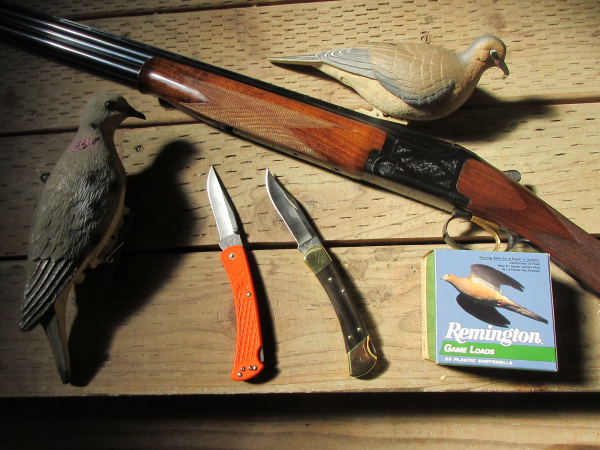
- Carry a sharp knife such as Buck’s 110+ or 112 Ranger Sport Knife. Both knives have thinner blades to aid with precision cutting and preparing dove breasts for the grill or skillet. One other knife to possibly take along to the dove field is the Buck 112 Slim Pro TRX Knife with an orange handle. This ensures it will perform well—and not be easily lost in the field or at the dove cleaning site.
- Use a hunting dog when possible to find all downed birds, and bring water—plus a bowl—for the dog to drink from. Note that many hunters leave the field because they are thirsty, so also pack water for yourself.
- Use dove decoys when possible and place these around your location so approaching and passing doves can easily see these. (Be sure to check your local laws, as decoying isn’t legal everywhere.) Also remember to carry a hunting stool or chair to the field so you can remain comfortable … most dove hunts are all-day events.
Once the birds are cleaned, fire up the grill — a homemade barbecue sauce from Popular BBQ is perfect for bacon-wrapped dove.
More wingshooting ahead? See our spring turkey hunting checklist.
More dove hunting on Popular Outdoorsman
- Dove hunting gear: 12 essentials before opening day
- Dove season 2026: dates, limits and where to go
- How to age a deer on the hoof — for when the season turns
Dove hunting tips worth remembering next season
Write down what worked: which field, which corner, what time the birds moved and what the wind was doing. Dove hunting tips from a magazine are general; the notes from your own field are specific, and they are worth more every year you keep them.
Reader Favorites
Field-to-table reference desk
From tag to table — official season dates for all 50 states, plus safe doneness temps for your harvest.
| Species | Archery | Firearm |
|---|---|---|
| Deer | Sep–Oct | Nov |
| Elk | Sep | Oct–Nov |
| Turkey | — | Apr–May |
All 50 state wildlife agencies, plus how seasons, tags and licenses work.
Find your state → Network| Doneness | Target |
|---|---|
| Rare | 125–130°F |
| Medium-rare | 130–135°F |
| Well-done | 160°F+ |
Safe pull temps for venison and steak, from Popular BBQ.
View full chart →