Wind & Sea: Let’s Go Kite Fishing!
Quick Answer
Originally published: April 2, 2024
Kite fishing is an offshore technique where you fly a kite from the boat and hang live baits from it, suspending them right at the surface. Because only the leader and bait touch the water — the line stays up in the air — line-shy species like sailfish, tuna and kingfish cannot see or feel it, making for an incredibly natural, effective presentation. When a fish bites, the line pops from a release clip and the fight is on.


Kite fishing: quick facts
How does kite fishing work?
A kite flown off the boat holds fishing lines above the water via release clips; each line drops a live bait to the surface. When a fish strikes, the line releases from the clip and you fight the fish normally.
Why is kite fishing so effective?
It keeps the line out of the water, so line-shy pelagics like sailfish and tuna do not detect it, and the splashing surface bait is a very natural, tempting target.
What fish do you catch kite fishing?
Surface-feeding pelagics — sailfish, tuna, kingfish, wahoo and mackerel are common targets.
What gear do you need?
A fishing kite (often with an electric kite reel), release clips, and conventional rods; sailfish and tuna rigs typically use 20 to 40 lb fluorocarbon and 4/0 to 6/0 circle hooks.
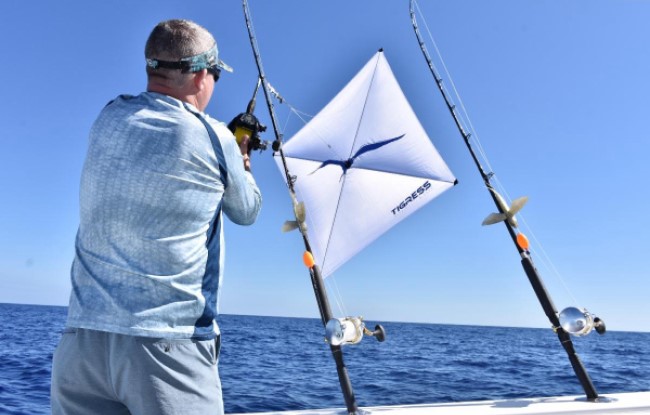
Offshore angling just got a lot more kino …
Ever heard of kite fishing? It’s an exhilarating fishing strategy that harnesses the power of ocean wind to create irresistible attraction. The kite keeps live baits on the water’s surface, creating a realistic presentation for surface-feeding fish. As anglers deploy the kites, a large surface area across the ocean gets coverage as the bait fish entices the target predator to come up for a quick bite. This technique is most known for catching sailfish. However, kite fishing will attract other species, such as dolphins, mahi-mahi, wahoo, king mackerels, and tuna.
Offshore fishing often comes with a wide variety of winds and sea conditions. Like the traditional kite, the wind will play a role in the kite’s ability to fly. Tigress Outriggers offers fishing kites and kit, fine-tuned for each type of wind, whether light or strong. The options available are the Specialty Lite Wind Kite, the All Purpose Kite, and the Hi-Velocity Kite.
Constructed to fly at wind speeds from 5-15 plus MPH, each design has a sturdy and dependable structure. Simple adjustments on the Lite Wind Kite allow reliable flight in 5-10 MPH winds, while the All Purpose Kite is best in 10-15 MPH winds. The Hi-Velocity Kite, completed with four holes in the custom fabric, allows the kite to fly in higher-velocity wind days. Helium balloons play a vital role on almost windless days by keeping the kite airborne and flying correctly.
Tigress is a one-stop shop for all Kite fishing gear needs. From kites to rod holders and accessories, fishermen can find high-quality gear built to last that also aesthetically matches boats of all varieties. For more information, visit https://www.tigressoutriggers.com.


Reader Favorites
Field-to-table reference desk
From tag to table — official season dates for all 50 states, plus safe doneness temps for your harvest.
| Species | Archery | Firearm |
|---|---|---|
| Deer | Sep–Oct | Nov |
| Elk | Sep | Oct–Nov |
| Turkey | — | Apr–May |
All 50 state wildlife agencies, plus how seasons, tags and licenses work.
Find your state → Network| Doneness | Target |
|---|---|
| Rare | 125–130°F |
| Medium-rare | 130–135°F |
| Well-done | 160°F+ |
Safe pull temps for venison and steak, from Popular BBQ.
View full chart →