Hunter Vision: Why Your Eyes See Green Better
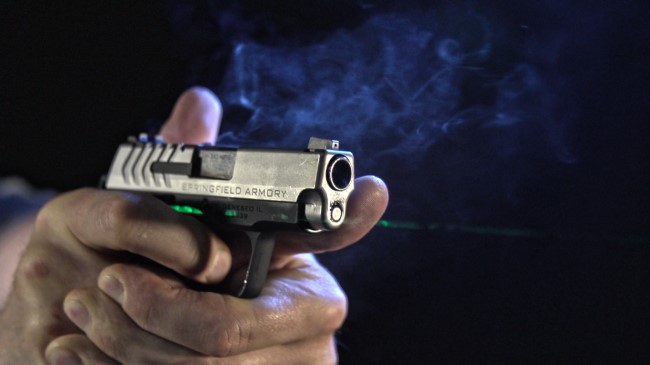
Viridian, a company dedicated to making aiming as fast and efficient as possible, is offering some free and valuable insights for hunters and self-defenders, and is doing so with both feet firmly rooted in the science of human biology. Knowing what you can and can’t see is just as important as knowing what any big game you may be trying to stalk can and can’t see. Here’s what you need to know about color theory and how that translates into your sight-acquisition strategy.
There are two primary colors when discussing firearm laser sights – red or green. To understand the difference, we must first understand what a laser is and how we perceive color in the natural world. The word LASER is an acronym for Light Amplification by Stimulated Emission of Radiation. This means that the laser both produces and amplifies light, by means of stimulated emission of electromagnetic radiation. The process essentially concentrates one wavelength, or color, of light. What the human eye sees as “color” is electromagnetic radiation ranging from wavelengths of 390 nanometers (violet) to 700 nanometers (red). Wavelengths under 390 nanometers are considered ultraviolet light and wavelengths over 700 nanometers are considered infrared light, both of which are invisible to the human eye.
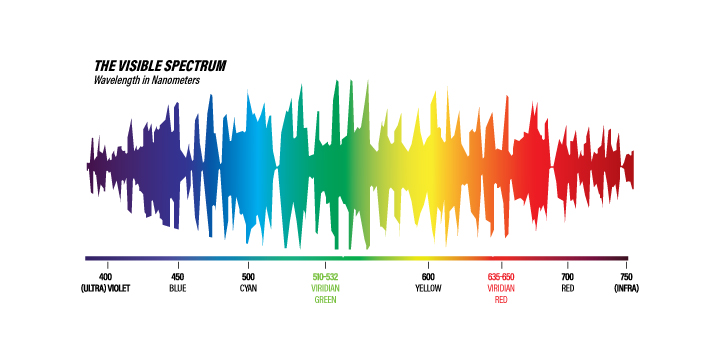
The real-world difference between red and green laser sights is their visibility in the daylight. Green light is notably easier to distinguish than red light because it triggers a much higher number of receptor cells in the human eye. Viridian Green Lasers utilize a 510-532nm wavelength range near the center of the visible spectrum, creating an optimum targeting dot that’s up to 50x brighter than the conventional red, visible at all times, under all conditions, and effective at distances no ordinary laser can achieve indoors or outdoors.
This bright-light performance is a very important distinction to make when choosing what color site is right for you. If you are not particularly concerned with laser visibility in the daylight and looking to save some money, a red laser site would be a good choice. If you are interested in using your laser sight in all lighting conditions, you should choose a green laser. Whatever your preference, Viridian has a diverse range of affordable options to fit your needs
Red lasers and red dot optics have had a tenured, but challenging history in the firearm industry due to technology and product development shortcomings. This resulted in a limitation that prohibited shooters ability to aim effectively.
Viridian’s weapon accessories are meant to get shooters on target fast. Its green lasers are the most powerful lasers built for EDC and tactical shooters — visible up to two miles in darkness. And now Viridian is taking advantage of our eyes sensitivity to green and adding even more functionality to aiming devices built for pistols, long guns, and shotguns. The company has some exciting and innovative based on this science … and we at Popular Outdoorsman will be bringing you the news!
Reader Favorites
Field-to-table reference desk
From tag to table — official season dates for all 50 states, plus safe doneness temps for your harvest.
| Species | Archery | Firearm |
|---|---|---|
| Deer | Sep–Oct | Nov |
| Elk | Sep | Oct–Nov |
| Turkey | — | Apr–May |
All 50 state wildlife agencies, plus how seasons, tags and licenses work.
Find your state → Network| Doneness | Target |
|---|---|
| Rare | 125–130°F |
| Medium-rare | 130–135°F |
| Well-done | 160°F+ |
Safe pull temps for venison and steak, from Popular BBQ.
View full chart →

Great tech research article Trace. I have wondered many times which is better for Hunter Vision, Green vs Red laser and why, now I know and understand why, thank you Sir!
I appreciate your articles and I am not trying to be overcritical, but you could use a good proofreader or editor to catch things like sight vs. site, for instance.
Part of using red vs green laser may be due to military applications. When I was a tank crewman the reticle on M1 tank sights was red, and the gun was slaved to the sight. The reticle on the British Challenger tank was a green dot and the sight was slaved to the gun. When you lased to the target on an M1 the reticle stayed on target and the turret shifted. On the Challenger, the gun stayed on target and the green dot shifted. Good luck finding a green reticle against a green background in the field…
I am color blind to some colors. Especially Green. Red I can see, even though it has a shorter range than green. A green laser during the day gets washed out by daylight. Red shines through for me. My AR has a Red/ Green site and I had to add iron sights in order to use it during the day to target farther. This article is good but doesn’t help those who need further assistance when the Green Sites don’t work for those who can’t see it. This was not covered in this article.
One might also consider that, for some reason, green lasers can have difficulty performing in cold temperatures (I believe below freezing), while red lasers don’t have that issue. Also green lasers eat up much more battery power compared to their red counterparts. I’ve had 6 red lasers (including a Viridian model), though I intend to try a green one soon.
A lot of males are color blind and red is not a good color. I am total color blind and can not see red at all. I can not see when you step on the brakes on your car. NO Light. Rainbows are two colors to me, either yellow or blue, no other colors can be seen. Why firetrucks and stop signs are red is beyond my pay grade. Because of that I do not use a laser and it adds a couple of seconds because you are confirming the object.