How to Purify Water in the Wild: Every Method That Actually Works
Last updated: October 9, 2026 · Originally published September 21, 2026
Giardia, Cryptosporidium, E. coli and cholera are invisible in clear water, so these are the purification methods that reliably remove them.
Waterborne illness from untreated water is one of the fastest-moving threats in any survival or emergency scenario. Giardia, Cryptosporidium, E. coli, and cholera are invisible, and even clear, cold mountain streams carry organisms that cause severe incapacitation within 24–72 hours of consumption. The good news: every method on this page kills or removes these organisms when applied correctly.
This guide covers every reliable method for how to purify water in the wild: boiling, chemical treatment, filtration, and solar disinfection. It also covers what each method does and doesn’t remove — a critical distinction that determines when you need to combine methods. Pair this with the 72-hour emergency kit and the best survival water filters guide for a complete water security plan.
What You’re Purifying Against
Water contamination falls into three categories, each requiring different treatment:
- Biological contaminants: Bacteria (E. coli, Salmonella, Cholera), viruses (Hepatitis A, Norovirus, Rotavirus), and protozoa (Giardia, Cryptosporidium). These are the primary threat in natural water sources and are killed or removed by boiling, chemical treatment, UV purification, and quality filtration.
- Chemical contaminants: Pesticides, heavy metals (lead, arsenic), industrial chemicals, and nitrates. These are NOT removed by boiling, UV, or most portable filters. Activated carbon filtration removes some chemical contaminants; reverse osmosis removes most. In a wilderness survival context, avoid visibly polluted or strangely-colored water sources entirely.
- Particulate matter: Sediment, soil, organic debris. Physically visible in turbid water. Doesn’t cause illness directly but reduces chemical treatment effectiveness and clogs filters. Pre-filter turbid water through a cloth or bandana before applying other treatment methods.


Method 1: Boiling — The Most Reliable and Universal Method
Boiling is the gold standard of water purification because it reliably kills every biological contaminant — bacteria, viruses, and protozoa — without requiring any carried supplies beyond a container and a fire. When in doubt about any other method’s effectiveness, boiling provides certainty.
Boiling Time Requirements
- At sea level to 6,500 feet elevation: Bring water to a rolling boil for 1 minute. At sea level, water boils at 212°F — hot enough to kill all pathogens nearly instantly. The 1-minute hold ensures complete kill across the entire volume.
- Above 6,500 feet elevation: Boil for 3 minutes. At higher altitudes, water boils at lower temperatures (below 200°F above 6,500 feet), which reduces the kill rate. The extended boil time compensates.
Practical Boiling Notes
Boiled water tastes flat because dissolved oxygen is expelled during boiling. Improve taste by pouring the water back and forth between containers several times to re-oxygenate, or by adding a small pinch of salt per liter.
Boiling does not remove chemical contaminants, heavy metals, or salt. If the source water has any chemical contamination risk, use a different or additional method.
Any container that can hold water and withstand heat works for boiling: metal cups, pots, improvised bark containers (birch bark folded into a cup won’t burn if kept full of water), or even a plastic bottle held above — not in — a flame on a stick. The water absorbs the heat before it reaches the plastic.
Method 2: Chemical Treatment
Chemical treatment is the lightest-weight purification method for carried supplies. Purification tablets weigh less than a few grams and fit in any pocket. Chemical treatment is highly effective against bacteria and most viruses but has limitations against Cryptosporidium that must be understood before relying on it as a sole method in areas with grazing animals.
Household Bleach (Sodium Hypochlorite)
Regular unscented household bleach (6–8.25% sodium hypochlorite) purifies water effectively and is available anywhere. It’s not the most packable option but is an important backup when dedicated tablets aren’t available.
- Clear water: Add 2 drops (approximately 0.1mL) of 6% sodium hypochlorite per liter. Stir and let stand 30 minutes before drinking.
- Cloudy water: Pre-filter through cloth, then add 4 drops per liter. Let stand 60 minutes.
- Cold water (below 40°F): Double the dose and extend contact time to 60 minutes — cold water slows the chemical reaction.
After treatment, the water should have a faint chlorine smell. If it doesn’t, repeat the dose and wait another 15 minutes. No smell at all indicates the bleach may be expired or too dilute.
Iodine Tablets
Iodine tablets (Globaline, Potable Aqua) are effective against bacteria and most viruses, but ineffective against Cryptosporidium. Follow package directions — typically one tablet per liter, 30-minute contact time. Iodine leaves a noticeable taste; neutralizer tablets (included in most kits) reduce it significantly.
Important medical caveat: iodine is contraindicated for pregnant women, people with thyroid conditions, and those with shellfish allergies. These users should use chlorine dioxide instead.
Chlorine Dioxide Tablets (Aquatabs, Katadyn Micropur)
Chlorine dioxide is the most effective single chemical treatment method because it kills bacteria, viruses, AND Cryptosporidium — making it the only chemical treatment that covers the full biological spectrum. The trade-off: it requires a 4-hour contact time for Cryptosporidium kill (30 minutes for bacteria and viruses).
- Bacteria and viruses: 30-minute contact time
- Cryptosporidium: 4-hour contact time in clear, cold water
Chlorine dioxide tablets (Katadyn Micropur, Aquatabs) are the recommended chemical backup for backcountry use where Cryptosporidium is a realistic risk — anywhere with cattle, sheep, deer, or beaver activity upstream.

Method 3: Filtration
Portable water filters remove biological contaminants by forcing water through a porous membrane with openings too small for bacteria and protozoa to pass through. Key distinction: most portable filters do NOT remove viruses. In North America, virus risk in backcountry water is generally low, making filters adequate for most wilderness use. In international travel or areas with human fecal contamination, use a filter that adds chemical treatment, or combine filtration with chemical treatment.
Filter Ratings Explained
- 0.2 micron filter: Removes bacteria and protozoa (Giardia at 8–12 microns, Cryptosporidium at 4–6 microns, bacteria at 0.2–10 microns). Does not remove viruses (0.02–0.2 microns).
- Purifiers (0.02 micron or chemical stage added): Remove viruses in addition to bacteria and protozoa. Sawyer Squeeze, MSR Guardian, and Katadyn BeFree with iodine treatment all qualify.
Recommended Portable Filters
- Sawyer Squeeze ($30–$40): The best value portable filter. 0.1-micron hollow fiber filter removes bacteria and protozoa. Weighs 3 oz. Rated to 100,000 gallons with proper backwashing. Pairs with a standard 28mm water bottle thread for versatility.
- MSR Guardian ($350): The standard recommendation for international travel or areas with high virus risk. Pumped purifier that removes bacteria, protozoa, and viruses. Self-cleans with every pump stroke — no backwashing required. Heavy at 17.3 oz but operates in any condition.
- LifeStraw ($15–$20): Budget straw-style filter rated to 1,000 liters. 0.2-micron filter removes bacteria and protozoa. Limitations: drinks directly from source only (can’t fill a container), cannot filter standing water above the filter level, short service life compared to Sawyer. Best as an emergency backup.

Method 4: Solar Disinfection (SODIS)
SODIS uses sunlight’s UV-A radiation to kill waterborne pathogens. It requires no supplies beyond a clear plastic bottle (PET #1 plastic or glass) and 6+ hours of direct sunlight. It’s a last-resort technique — effective when no other method is available, but dependent on weather and takes the longest of any method.
SODIS Technique
- Fill a clear PET plastic bottle (recycled water bottle) or glass bottle with water. Pre-filter turbid water until it reads below 30 NTU (roughly, you should be able to read newsprint through the filled bottle).
- Place the bottle on a reflective surface (aluminum foil, sheet metal, white rock) in direct sunlight.
- Leave for 6 hours in full sun, or 2 days in overcast conditions. If clouds cover more than 50% of the sky, double the exposure time.
- After treatment, the water is safe from bacteria and viruses but not Cryptosporidium. Combine with chlorine dioxide treatment for full spectrum coverage.
SODIS has been validated by WHO for emergency water treatment in resource-limited settings. It is effective but weather-dependent and slow. Use it as a supplementary method or when no alternatives exist.
Combining Methods for Maximum Safety
The most reliable water treatment in any scenario combines filtration with chemical treatment or boiling:
- Filter then treat chemically: A Sawyer filter removes bacteria and protozoa (including Cryptosporidium). Adding a chlorine dioxide tablet after filtration adds virus coverage. This combination covers the full biological spectrum faster than either method alone.
- Pre-filter turbid water before any treatment: Cloth, bandana, or coffee filter removes sediment that reduces chemical treatment effectiveness and clogs mechanical filters. This step takes 30 seconds and extends filter life dramatically.
- Boiling as backup: In any scenario where you’re uncertain whether your filter or chemical treatment worked correctly — or where you suspect chemical contamination — boiling removes all biological risk from the equation.
Recognizing High-Risk Water Sources
Not all natural water carries equal risk. Prioritize these sources when available:
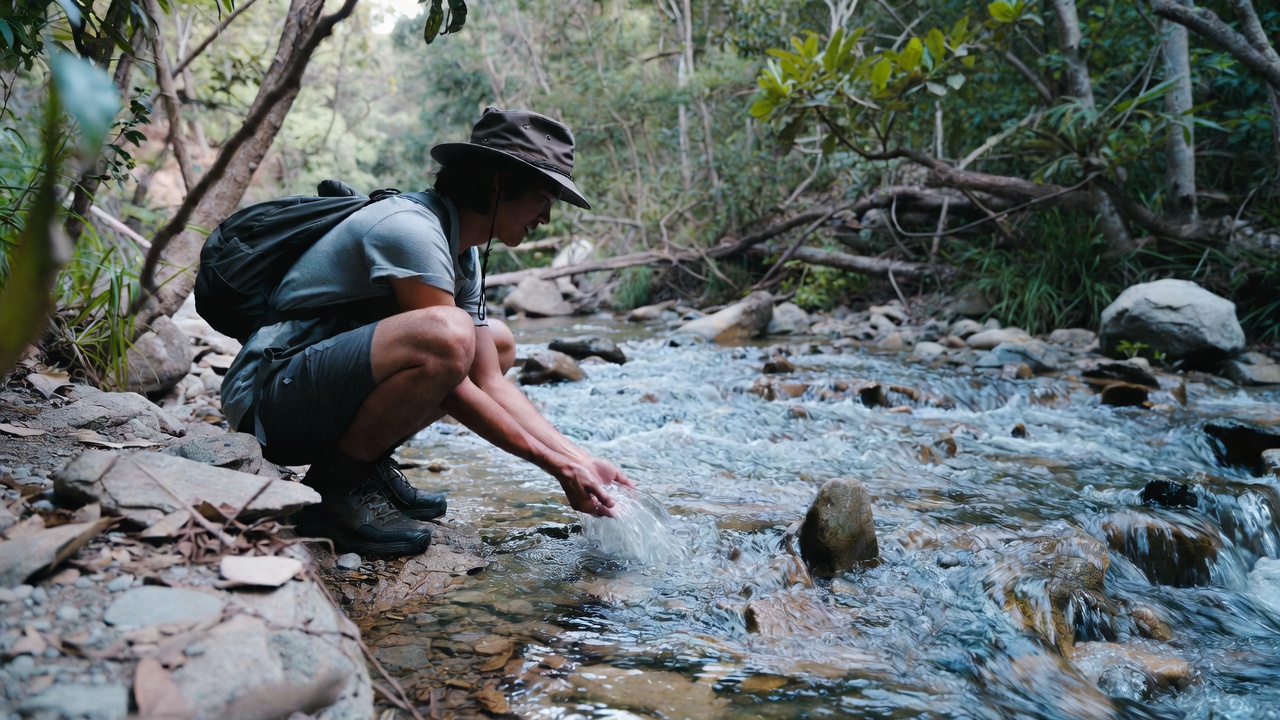
- Flowing water over rocks: Lower biological load than stagnant water. Higher flow rate reduces bacterial concentration.
- High-elevation springs: Water emerging directly from the ground above any upstream contamination source. Lowest risk of any natural source.
- Rainwater collected off clean surfaces: Microbiologically safe in most circumstances. The collection surface matters — asphalt and treated wood roofs introduce chemical contamination.
Avoid: stagnant ponds with visible algae, water downstream of grazing areas, water near human settlements or agricultural runoff, water with unusual color or odor. No treatment method fully compensates for heavily contaminated source water.
Frequently Asked Questions About Purifying Water
How long do I need to boil water to purify it?
Boil for 1 minute at sea level through 6,500 feet elevation. Boil for 3 minutes above 6,500 feet, where the lower boiling point of water reduces pathogen kill efficiency. A rolling boil — not a simmer — is required. Boiling kills all bacteria, viruses, and protozoa but does not remove chemical contaminants, heavy metals, or salt. For chemically contaminated water, use activated carbon filtration or avoid the source.
What’s the correct bleach dosage for water purification?
Use 2 drops of unscented household bleach (6% sodium hypochlorite) per liter of clear water. Let stand 30 minutes before drinking. For cloudy water, use 4 drops per liter and wait 60 minutes. Cold water (below 40°F) requires double the dose and 60-minute contact time. After treatment, the water should have a faint chlorine smell — if it doesn’t, repeat the dose. Bleach treats bacteria and viruses but not Cryptosporidium, so it is not a complete solution in areas with grazing animals upstream.
Does boiling remove all contaminants?
No. Boiling kills all biological contaminants — bacteria, viruses, and protozoa — but does not remove chemical contaminants including heavy metals, pesticides, industrial chemicals, or salt. In wilderness settings where the source water is free of industrial contamination, boiling provides complete biological protection. For water near agricultural areas, mines, or industrial sites, use activated carbon filtration or avoid the source entirely. Salt concentration is not reduced by boiling — seawater or brackish water requires distillation.
Published by Chad Dyer, President, Brand Avalanche Media, Inc. Popular Outdoorsman is an independent editorial publication. Product recommendations reflect editorial judgment based on field experience and specifications review.


Reader Favorites
Field-to-table reference desk
From tag to table — official season dates for all 50 states, plus safe doneness temps for your harvest.
| Species | Archery | Firearm |
|---|---|---|
| Deer | Sep–Oct | Nov |
| Elk | Sep | Oct–Nov |
| Turkey | — | Apr–May |
All 50 state wildlife agencies, plus how seasons, tags and licenses work.
Find your state → Network| Doneness | Target |
|---|---|
| Rare | 125–130°F |
| Medium-rare | 130–135°F |
| Well-done | 160°F+ |
Safe pull temps for venison and steak, from Popular BBQ.
View full chart →