Best GMRS Radios 2026: Top Picks for Range, Family Use, and Emergency Prep
Last updated: October 6, 2026 · Originally published September 28, 2026
GMRS radios compared for 2026 on range, family use and licensing, with the practical limits that manufacturer range claims never mention.
GMRS — General Mobile Radio Service — is the most practical two-way radio option for most families, outdoors enthusiasts, and emergency preparedness plans. It offers significantly more power and range than FRS walkie-talkies, requires only a simple FCC license (no test, $35 for 10 years covering the entire family), and with repeater access can reach 50+ miles in the right setup. It sits in a practical middle ground between the no-license FRS radios (limited range and power) and amateur ham radio (significant licensing requirements and technical knowledge).
This guide covers the best GMRS radios in 2026 across every use case: mobile vehicle units, handheld portables, base stations, and budget options. It also covers the license requirements, range realities, repeater access, and the GMRS vs. FRS vs. ham radio comparison that helps you choose the right radio tier for your needs. For a complete communications plan, pair this with the best emergency radio guide and the ham radio beginners guide.

GMRS vs. FRS vs. CB vs. Ham Radio
Understanding where GMRS fits in the radio landscape prevents buying the wrong tool. Each radio tier has a specific role.
FRS (Family Radio Service)
FRS radios require no license and are sold as consumer walkie-talkies everywhere. The limitation: FCC rules cap FRS radios at 2 watts maximum power on most channels, and the antennas are fixed (non-removable). Real-world range in typical terrain is 0.5–2 miles. FRS is appropriate for short-range communication at campgrounds, ski resorts, or theme parks. It is not adequate for emergency preparedness, hunting, or any situation where range beyond 1–2 miles matters.
GMRS (General Mobile Radio Service)
GMRS operates on the same frequency band as FRS (462–467 MHz) but allows up to 50 watts output power, removable antennas, and — critically — repeater use. A GMRS repeater is a fixed station that receives your signal and retransmits it at higher power from an elevated location, dramatically extending range. GMRS requires an FCC license ($35, 10-year term, covers all immediate family members, no exam required). For most outdoor and emergency preparedness applications, GMRS is the correct radio tier.
CB (Citizens Band)
CB radio operates in the 27 MHz HF band, requires no license, and was the dominant vehicle communication system for decades. CB has largely been replaced by GMRS for most consumer uses — its lower frequency means more interference and less range in most conditions. CB remains relevant for long-haul truck communication along interstates and has a large installed base in rural areas. For general outdoor use, GMRS provides better performance.
Ham (Amateur) Radio
Amateur radio offers the widest frequency range, highest power limits, and most versatile communication options — but requires passing a licensing exam (Technician class minimum). For serious emergency communication planning, ham radio’s capabilities exceed GMRS significantly. For most families and outdoor enthusiasts who want practical two-way communication without technical study, GMRS is the better starting point.


GMRS License: What You Need to Know
The GMRS license is an FCC Part 95 license issued under the call sign system. Key facts every prospective GMRS user should understand:
- Cost: $35 for a 10-year license term
- Who it covers: The licensee and all immediate family members (spouse, children, parents, siblings, grandparents, grandchildren) — one license covers the whole household
- No exam required: Unlike amateur radio, GMRS requires only an online FCC application at wireless.fcc.gov/uls
- Processing time: Typically 1–3 business days online
- Penalty for unlicensed operation: The FCC has issued fines of $10,000–$100,000 for unlicensed GMRS operation. The risk is low but the penalty is significant — the license is worth the $35
- Station identification: Licensed GMRS operators must identify by call sign every 15 minutes during a conversation and at the end of each transmission
Mobile vs. Handheld: Which GMRS Radio Type Do You Need?
Handheld GMRS Radios
Handheld GMRS radios (2–5 watts typical) are the most versatile option for most users. They’re portable, battery-powered, and cover the core use cases: hiking, hunting, camping, and neighborhood emergency communication. The limitation is power — 5 watts provides much shorter range than a 50W mobile unit, especially in terrain with obstructions. Most handheld GMRS radios have removable antennas, allowing aftermarket antenna upgrades that improve range over stock.
Mobile GMRS Radios
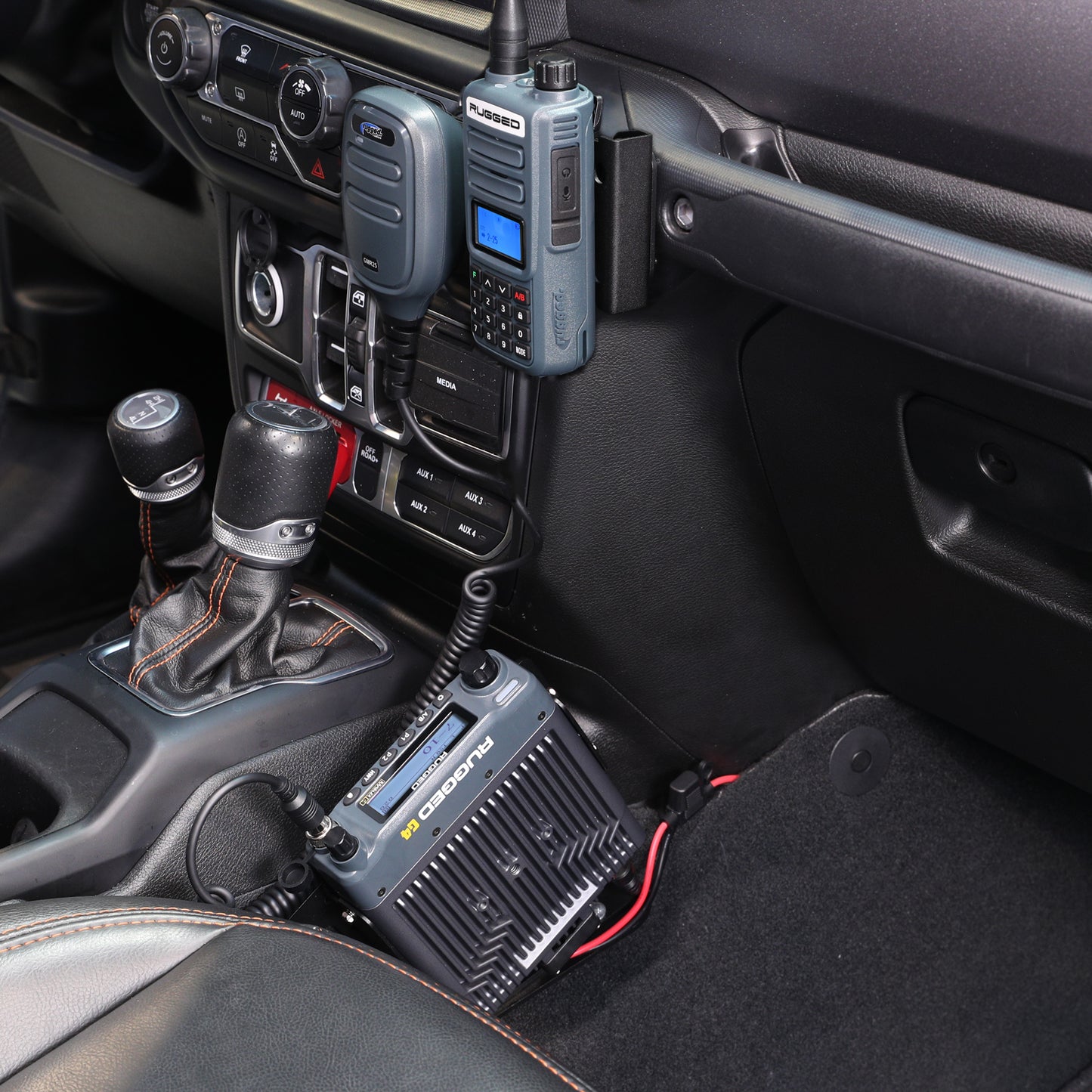
Mobile units (25–50 watts) mount in vehicles and connect to 12V power, delivering substantially more range than handheld radios. A 50W GMRS mobile with a rooftop antenna achieves line-of-sight range of 25–50 miles in open terrain and 5–15 miles through moderate terrain. Mobile units are the correct choice for off-road vehicle convoys, ranch and farm communication, and any application where a vehicle is the base of operations. They also work as home base stations connected to a 12V power supply.
Range Realities
GMRS radio marketing range claims (often 25–35 miles on handheld packaging) assume flat, open terrain with no obstructions — conditions that rarely exist in practice. Realistic range expectations: handheld-to-handheld in forest or hilly terrain, 1–3 miles; handheld-to-mobile in moderate terrain, 5–10 miles; mobile-to-mobile in open terrain, 15–30 miles; handheld-to-repeater, up to 25 miles depending on repeater elevation. Repeater access is the single biggest range multiplier in the GMRS system.
Best GMRS Radios 2026
1. Midland MXT500 — Best Mobile GMRS Radio
The Midland MXT500 is the standard recommendation for vehicle-mounted GMRS communication. Its 50-watt output puts it at the maximum legal GMRS power level, and the external antenna connection (standard PL-259/SO-239 connector) accepts any aftermarket vehicle antenna. The MXT500 covers all 30 GMRS channels including the 8 repeater channels, has NOAA weather alert capability, and its compact head unit separates from the main radio body for flexible mounting in tight cab spaces.
- Power: 50W
- Channels: 30 GMRS + NOAA weather
- Repeater capable: Yes — all 8 GMRS repeater channels
- Antenna: External, PL-259 connector (antenna sold separately)
- Power input: 12V DC
- Price: $130–$160
- Best for: Off-road vehicles, ranch and farm, vehicle convoy communication, home base station
Pair the MXT500 with a NMO-mount or mag-mount antenna for the best performance. A $30–$50 aftermarket antenna significantly improves range over any included antenna.
2. Midland T77VP5 — Best Handheld GMRS Radio Set
The Midland T77VP5 is the best value handheld GMRS radio kit for family and outdoor use. The dual-pack includes two 5W radios with repeater access, NOAA weather alerts, a backlit LCD display, and Midland’s X-TALKER waterproofing (submersible to 1 meter). The T77VP5 includes rechargeable battery packs and a dual desktop charging cradle, making it a complete out-of-the-box solution.
- Power: 5W
- Channels: 22 (GMRS/FRS) + NOAA weather
- Repeater capable: Yes
- Waterproofing: IPX4 (splash resistant) to IPX7 (1m submersion)
- Battery: Rechargeable NiMH + AA alkaline backup
- Price: $80–$100 (2-pack)
- Best for: Family outdoor use, hiking, camping, neighborhood emergency preparedness
3. Uniden SDS100 GMRS — Best Feature-Rich Handheld
The Uniden GMR5095-2CKHS is Uniden’s flagship handheld GMRS pair, offering 5W power, full repeater access, and one of the clearest audio outputs in the handheld category. Uniden’s GMRS radios have consistently outperformed Midland in audio clarity testing — a meaningful advantage in noisy outdoor environments (ATV, wind, stream noise). The included headset jacks and VOX (voice-activated transmission) capability make hands-free communication straightforward during active outdoor use.
- Power: 5W
- Channels: 50 channels (GMRS + NOAA)
- Repeater capable: Yes
- VOX: Yes — 9 sensitivity levels
- Battery: Rechargeable Li-ion + AA backup
- Price: $90–$120 (2-pack)
- Best for: Hunters, ATV riders, anyone prioritizing audio clarity and VOX capability
4. Motorola Talkabout T465 — Best Budget GMRS/FRS Hybrid
The Motorola Talkabout T465 is the best entry-level option for buyers who want GMRS capability without the full investment of a dedicated GMRS radio. It operates on both GMRS and FRS channels, making it compatible with both licensed and unlicensed users. At 2W on FRS channels and higher power on GMRS channels (with license), it covers the most common handheld use cases at a budget price. The T465 lacks repeater access — a meaningful limitation — but for short-range family communication and casual outdoor use, it performs correctly.
- Power: 2W (FRS) / higher on GMRS channels with license
- Channels: 22 (FRS/GMRS)
- Repeater capable: No
- Battery: AA alkaline (3)
- Price: $30–$45 (2-pack)
- Best for: Budget-conscious buyers, casual family outdoor use, short-range communication where repeater access isn’t needed
5. BTech GMRS-V1 — Best Value Programmable GMRS Radio
The BTech GMRS-V1 is the best option for technically inclined users who want full GMRS programmability at a low price point. It supports all GMRS channels including repeater channels, offers 5W output, and uses the Chirp software interface for programming — allowing custom channel naming, tone programming, and repeater offset configuration. The GMRS-V1 is particularly well-suited to users who want to access local GMRS repeater networks, which often require specific CTCSS tones programmed for access.
- Power: 5W
- Channels: Programmable (30 GMRS channels + more)
- Repeater capable: Yes — programmable CTCSS/DCS tones
- Programming: Chirp software (free, Windows/Mac/Linux)
- Price: $50–$70 (single)
- Best for: Repeater network access, technically capable users, value-conscious buyers who want full feature set
GMRS Repeater Access: Extending Your Range
Repeaters are the most significant range multiplier in the GMRS system. A GMRS repeater receives on one frequency and simultaneously retransmits on another from an elevated location — typically a hilltop, tower, or tall building. A handheld radio that reaches 2 miles direct can reach 15–30 miles through a well-positioned repeater.
Finding local GMRS repeaters: mygmrs.com maintains a user-contributed database of GMRS repeaters by location. Most repeaters list their input/output frequencies, CTCSS access tones, and coverage area. Many are open to all licensed GMRS operators; some require club membership or prior contact with the owner.
To access a repeater, your radio must be programmed with the repeater’s input frequency and the correct CTCSS tone. This requires either a programmable radio (BTech GMRS-V1, most mobile units) or a radio with tone programmability (most modern handhelds). The Motorola T465 and similar budget FRS/GMRS hybrids typically cannot access repeaters.
Frequently Asked Questions About GMRS Radios
Do I need a license to operate a GMRS radio?
Yes. The FCC requires a GMRS license for operation on GMRS frequencies. The license costs $35 for a 10-year term, covers all immediate family members, and requires no exam — only an online FCC application at wireless.fcc.gov/uls. Operating without a license exposes you to fines that have reached $100,000 in enforcement actions. The license is straightforward to obtain and the $35 cost is negligible relative to the radio investment. Technically, operating on shared FRS/GMRS channels at FRS power levels (2W max, fixed antenna) doesn’t require a license — but any radio capable of higher power or removable antennas requires one when used at those specifications.
What’s the real-world range of GMRS radios?
Marketing claims of 25–35 miles assume flat open terrain — conditions rarely encountered in practice. Realistic expectations: handheld-to-handheld in forest or hilly terrain, 1–3 miles; handheld-to-mobile unit in moderate terrain, 5–10 miles; mobile-to-mobile in open terrain, 15–30 miles. Repeater access dramatically extends these figures — a handheld radio through a well-positioned GMRS repeater can reach 20–50 miles depending on terrain and repeater elevation. For reliable multi-mile communication, a 50W mobile unit or repeater access is necessary.
Can GMRS radios communicate with standard walkie-talkies?
Yes, with conditions. GMRS and FRS share 22 channels (channels 1–22). A GMRS radio communicates with any FRS walkie-talkie on these shared channels — but only at the lower FRS power level if the other radio is an FRS-only device. GMRS radios cannot communicate with CB radios (different frequency band) or ham radios (different frequency band and protocols). For family or group communication where some members have budget FRS radios and others have GMRS radios, the shared channels work effectively for short-range coordination, while GMRS users can use repeater access and higher power for longer range communication among themselves.
Published by Chad Dyer, President, Brand Avalanche Media, Inc. Popular Outdoorsman is an independent editorial publication. Product recommendations reflect editorial judgment based on field experience and specifications review.


Reader Favorites
Field-to-table reference desk
From tag to table — official season dates for all 50 states, plus safe doneness temps for your harvest.
| Species | Archery | Firearm |
|---|---|---|
| Deer | Sep–Oct | Nov |
| Elk | Sep | Oct–Nov |
| Turkey | — | Apr–May |
All 50 state wildlife agencies, plus how seasons, tags and licenses work.
Find your state → Network| Doneness | Target |
|---|---|
| Rare | 125–130°F |
| Medium-rare | 130–135°F |
| Well-done | 160°F+ |
Safe pull temps for venison and steak, from Popular BBQ.
View full chart →