Deer Feeder Guide: Types, Setup and Baiting Laws
A deer feeder is legal to run in many states, but hunting over it is a separate question, and the answer changes by state and even county.
Last updated: October 11, 2026 · Originally published October 4, 2026
Deer feeders are one of the most searched pieces of hunting gear every fall, and one of the most misunderstood. Folks buy a feeder, fill it with corn, hang a camera on the next tree and figure they are set. Then they find out corn is not what a deer needs, the feeder is drawing hogs and raccoons, and in some places the whole setup is against the law.
Here is what the wildlife researchers and state agencies actually say about feeder types, what to put in them, how to set one up, and where you can legally hunt near one.

Check your state first. This article is general information, not legal advice. Baiting and feeding rules are set by each state and can change during a season, including new county bans after a disease detection. The state examples below were checked against official agency pages in September 2026. Confirm the current rule with your state wildlife agency before you place a feeder or hunt near one.
Deer Feeders at a Glance
- Two basic types: free-choice feeders that are always open, and timed feeders that release feed on a schedule.
- Corn alone is not enough: deer need 12 to 16 percent protein for growth and antlers, and corn falls short.
- Aflatoxin is real: corn left on the ground in summer heat tested over 1,000 ppb in 8 days.
- Feeding and baiting are not the same: many states allow one and ban the other.
- Disease: Wisconsin law forces baiting and feeding bans in any county with a confirmed CWD-positive deer.
What Are the Main Types of Deer Feeders?
A Texas A&M AgriLife publication on supplemental feeding (EWF-032) sorts feeders into three groups by cost: hand broadcasting on the ground, livestock-style troughs and cribs, and mechanical spin-cast feeders at the top of the price range. Most of what you see in stores falls into two camps.
- Gravity or free-choice feeders. A hopper that lets feed drop into a tray or tube as deer eat it. Simple and cheap, and the feed is out around the clock.
- Timed spin-cast feeders. A barrel on a tripod or hanging from a limb, with a battery timer that spins a plate and throws feed at set times. These cost more but put deer on a schedule.
- Timed trough feeders. A timer drops feed into a covered trough. Researchers at the Caesar Kleberg Wildlife Research Institute found controlled-time troughs delivered protein pellets with more than 90 percent efficiency.
That same Caesar Kleberg bulletin rated free-choice crib, plate and tube feeders “inefficient” for protein pellets, because feed gets wet, spills on the ground, and gets eaten by everything that is not a deer.

What Should You Put in a Deer Feeder?
Corn is cheap and deer love it, but it is candy, not a meal. The AgriLife publication says corn’s crude protein is “insufficient for growth, reproduction, lactation, and optimal antler production.” A deer can maintain itself on about 6 percent protein, but for growth and reproduction it needs 12 to 16 percent. Protein shows up in the rack, which is what you measure when you count points on a buck and score his antlers.
That is why ranch managers in South Texas feed protein pellets. The Caesar Kleberg bulletin cites a mix of 75 percent protein pellets (14 to 16 percent crude protein) and 25 percent shelled corn, and notes it took about four months to move deer from straight corn to that mix. Any change in feed should be gradual, because the AgriLife publication warns that new feeds can cause digestive stress, and even death, from acidosis.
The Aflatoxin Problem
Aflatoxin is a toxin made by mold on corn, and it gets worse in heat and humidity. The National Deer Association summarized the research: corn left on the ground in July exceeded 1,000 parts per billion after 8 days. Turkeys showed liver damage at 100 to 200 ppb, and fawns fed 800 ppb lost weight and suffered organ damage. The AgriLife publication says to feed only low-aflatoxin corn, under 50 ppb.
The fix is simple, and it comes straight from the NDA:
- Buy feed labeled as tested for aflatoxin, with a stated threshold.
- Put out only what the deer will eat in about three days.
- Clean the feeder regularly with 1 part bleach to 6 parts water.
How to Set Up a Deer Feeder
The Caesar Kleberg researchers tested feeders on the King Ranch in Texas, and a few of their numbers are worth borrowing:
- Trough height: deer used troughs set at 18 inches and would not use them at 32 inches.
- Keeping hogs and cattle out: they built pens at least 80 by 80 feet from 4-gauge stock panel with 4-inch openings, 30 to 32 inches tall, on tee posts every 10 feet, to keep livestock and other animals off the feed.
- Timer settings: each release put out 8 to 25 pounds, deer fed from the troughs for about 10 minutes on average, and activity peaked from 6:00 to 8:00 a.m. once the timer was running.
Those figures came from big South Texas ranches, so scale them to your ground. Put a trail camera on the feeder so you know what is really eating your feed. Our ranking of the best trail cameras can help you pick one. And if you want to feed deer year-round without a feeder at all, our guide to food plots for deer covers what to plant.
Is It Legal to Hunt Over a Deer Feeder?
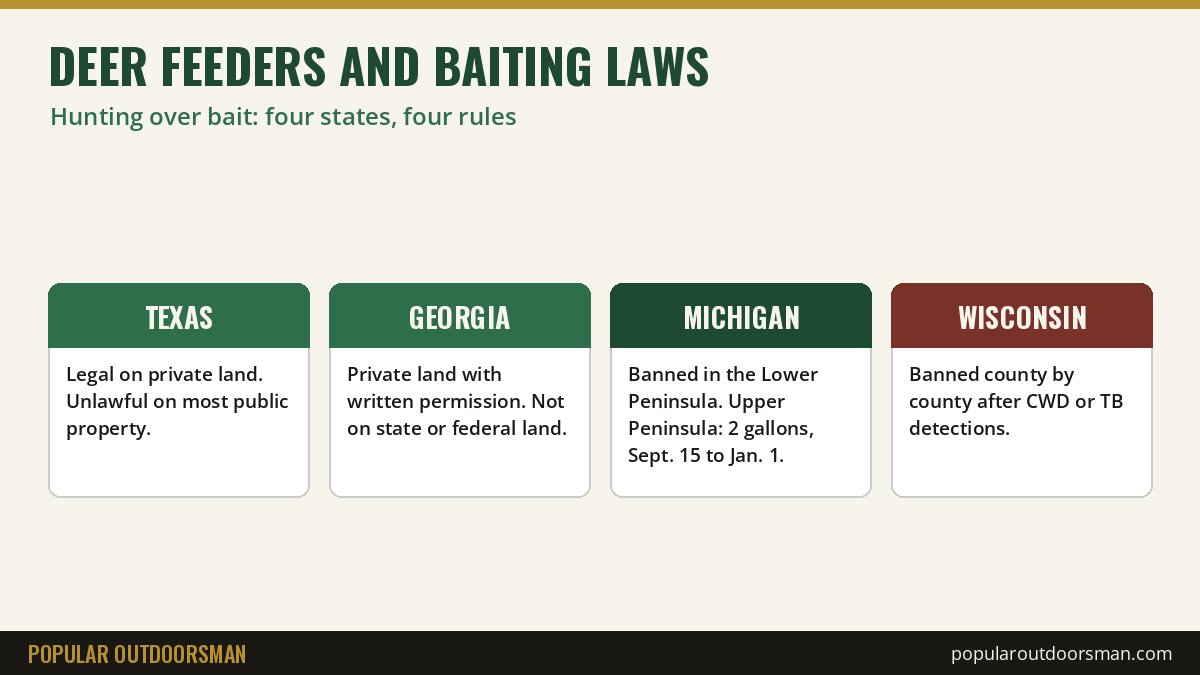
This is where people get in trouble. Feeding deer and hunting over bait are usually treated as two different things, and every state writes its own rules. Four examples show how far apart they are:
| State | Private land | Public land and limits |
|---|---|---|
| Texas | Bait is lawful for game animals, except wild turkey in the East Zone | “Baiting is unlawful on most public property” |
| Georgia | Deer and hogs may be hunted over bait in all counties, with written landowner permission | Unlawful to bait or hunt over bait on any state or federally managed land |
| Michigan | Lower Peninsula: baiting and feeding banned. Upper Peninsula: baiting allowed Sept. 15 to Jan. 1 | Upper Peninsula: 2 gallons per site, scattered over at least 10 by 10 feet |
| Wisconsin | Allowed only in counties not under a CWD or TB ban | 3-year ban in a county with a positive deer, 2-year ban in counties within 10 miles |
From Texas Parks and Wildlife’s means and methods rules, Georgia’s hunting regulations, the Michigan DNR baiting page and the Wisconsin DNR, checked September 2026.
Michigan has a lot of moving parts. The Lower Peninsula ban has a narrow exception for eligible hunters with disabilities during the Liberty and Independence Hunts. A bill to lift the Lower Peninsula ban, House Bill 4445, passed the Michigan House 66 to 44 on February 4, 2026, and was sent to the Senate Committee on Natural Resources and Agriculture. The Michigan DNR’s own baiting page still lists the Lower Peninsula ban as of September 2026, so the ban stands until a bill becomes law.
Wisconsin’s map changes with every new positive test. The Wisconsin DNR says bans “renew with each new wild or captive positive CWD/TB result,” and notes that without new detections, the Washburn County ban expires November 9, 2026.
Some states ban hunting over bait everywhere, so do not assume your state works like Texas. Our state hunting season regulation hub links to every state wildlife agency’s rules.
Do Deer Feeders Spread Disease?
They can. The AgriLife publication says concentrating animals “increases the transmission rate of diseases,” naming bluetongue, EHD and chronic wasting disease. The Wisconsin DNR puts it more directly: baiting and feeding “encourage deer to congregate unnaturally around a specific location.” CWD spreads through saliva, urine, feces and blood, and it lingers in the soil, which is exactly what a feeder site collects.
If you hunt where CWD has been found, read our guide to chronic wasting disease testing before the season.
Most of you process your own deer, start to finish.
Frequently Asked Questions
What is the best feed for a deer feeder?
The Caesar Kleberg bulletin cites 75 percent protein pellets at 14 to 16 percent crude protein and 25 percent shelled corn. Straight corn is short on protein and carries an aflatoxin risk in warm weather.
How high should a deer feeder trough be?
In the Caesar Kleberg study, deer used troughs at 18 inches and refused them at 32 inches.
What time should I set my deer feeder timer?
In the King Ranch research, deer at always-open feeders were most active in the late afternoon, and at timed troughs activity peaked from 6:00 to 8:00 a.m. once the timer was set. Set yours to the hours you plan to hunt or watch, where that is legal.
Is feeding deer in your backyard legal?
Not everywhere. Michigan bans feeding in the Lower Peninsula, and Wisconsin bans it in counties under a CWD or TB ban, with an exception for bird feeders within 50 yards of a home that deer cannot reach. Check your own state and county.
Buy a timed feeder, fill it with tested protein, keep it clean, and put a camera on it. Then check your state’s baiting rule before you hang a stand anywhere near it. Guns and Gadgets Daily has a good checklist of five ways to prepare for the first sit, including pulling your camera cards.
Sources: Tomeček and Redmon, “Supplemental Feeding of White-Tailed Deer,” Texas A&M AgriLife EWF-032; Caesar Kleberg Wildlife Research Institute, protein pellet feed-delivery bulletin (Kozicky, King Ranch); National Deer Association, “Aflatoxin in Corn Harms Deer and Turkeys” (2022); Texas Parks and Wildlife Department, hunting means and methods; Georgia hunting regulations, definitions (eRegulations); Michigan DNR, baiting and feeding regulations; Wisconsin DNR, baiting and feeding regulations and September 2025 release; WRCO News, September 14, 2026; Michigan State University Spartan Newsroom on House Bill 4445.
Reader Favorites
Field-to-table reference desk
From tag to table — official season dates for all 50 states, plus safe doneness temps for your harvest.
| Species | Archery | Firearm |
|---|---|---|
| Deer | Sep–Oct | Nov |
| Elk | Sep | Oct–Nov |
| Turkey | — | Apr–May |
All 50 state wildlife agencies, plus how seasons, tags and licenses work.
Find your state → Network| Doneness | Target |
|---|---|
| Rare | 125–130°F |
| Medium-rare | 130–135°F |
| Well-done | 160°F+ |
Safe pull temps for venison and steak, from Popular BBQ.
View full chart →