Legal Shooting Hours by State and the November Time Change
Legal shooting hours for deer start 30 minutes before sunrise and end 30 minutes after sunset in most states, but not in all of them.
Last updated: October 20, 2026 · Originally published October 19, 2026
Safety and legal note. This article is general information, not a substitute for a hunter education course. Positively identify your target and what is beyond it before every shot. Check your state wildlife agency’s current regulations before you hunt.

Legal shooting hours are the part of each day your state lets you take game, and for deer most states set them from 30 minutes before sunrise to 30 minutes after sunset. The rule is tied to the sun, not the clock, so the first and last legal minutes move a little every day. Outside that window, a shot breaks the game law of every state that sets one (Alaska sets none for big game, and we will get to that).
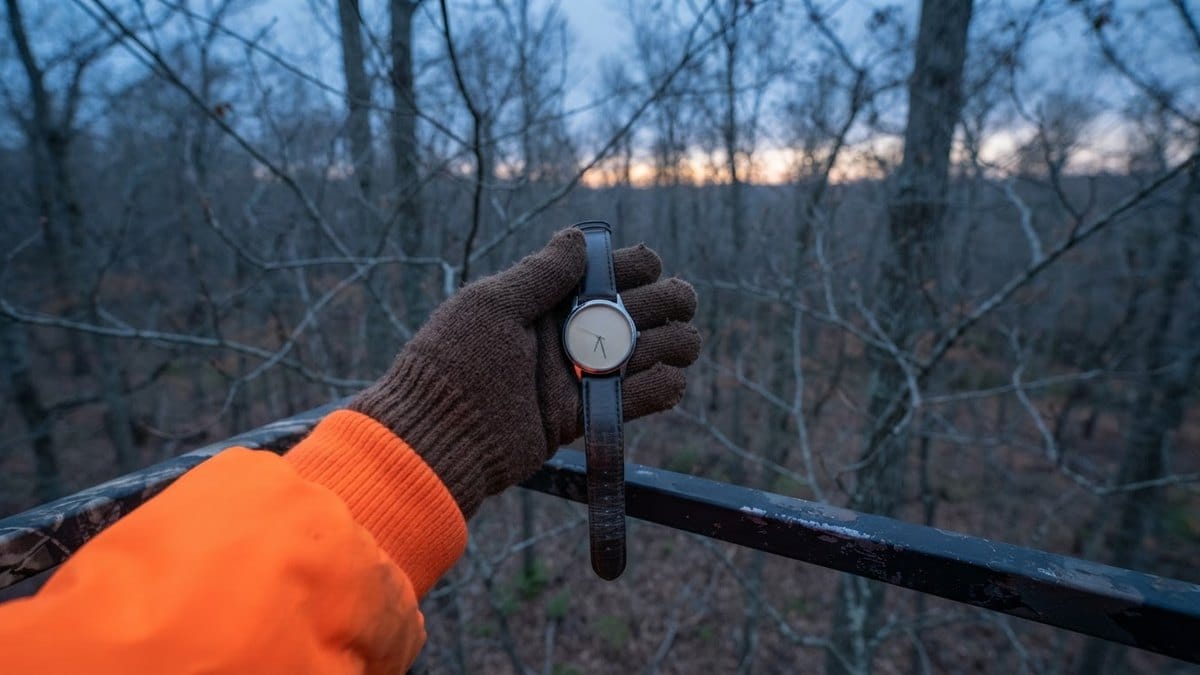
Then the first Sunday in November shows up. Daylight saving time ends at 2 a.m., the clocks fall back an hour, and every time you wrote down in October is wrong by that same hour. In the morning that only costs you hunting. In the evening it can cost you a citation, because the last legal minute now lands an hour earlier on the clock (the deer, sadly, do not wear watches).
Legal Shooting Hours at a Glance
- The usual rule: 30 minutes before sunrise to 30 minutes after sunset, in 45 of the 50 states in our table.
- The odd ones: South Carolina gives an hour on each end, Wisconsin closes 20 minutes after sunset, Connecticut at sunset, Arizona says daylight hours and Alaska sets none.
- The time change: Clocks fall back at 2 a.m. on the first Sunday in November, so legal light comes about an hour earlier by the clock.
- Outside the window: In Illinois it is a Class A misdemeanor with a $500 to $5,000 fine.
Legal Shooting Hours by State
Every row comes from the state’s own rule or official guide, linked in the last column (some through Justia, Cornell’s Legal Information Institute or eRegulations, which carry the same text).
| State | Deer shooting hours (minutes) | Exceptions and notes | Official source |
|---|---|---|---|
| Alabama | 30 before sunrise to 30 after sunset | Birmingham table | 2026 Alabama digest |
| Alaska | No set hours for big game | No lights or night vision | Fish and Game statement |
| Arizona | Daylight hours, no fixed minutes | No daylight saving time | A.R.S. § 17-301(A) |
| Arkansas | 30 before sunrise to 30 after sunset | Night hunting banned | AGFC Code 05.02 |
| California | 30 before sunrise to 30 after sunset | All big game | 14 CCR § 352 |
| Colorado | 30 before sunrise to 30 after sunset | All big game | 2 CCR 406-2, #202 |
| Connecticut | 30 before sunrise to sunset | Damage permits: 30 after | Conn. Regs. § 26-86a-6 |
| Delaware | 30 before sunrise to 30 after sunset | Dover table | 2026-27 guide |
| Florida | 30 before sunrise to 30 after sunset | Archery the same | Fla. Admin. Code r. 68A-12.002 |
| Georgia | 30 before sunrise to 30 after sunset | Night hunting banned | O.C.G.A. § 27-3-2; 27-1-2(45) |
| Hawaii | 30 before sunrise to 30 after sunset | No daylight saving time | Haw. Admin. R. § 13-123-6 |
| Idaho | 30 before sunrise to 30 after sunset | All big game | IDAPA 13.01.07.400 |
| Illinois | 30 before sunrise to 30 after sunset | Archery the same | 17 Ill. Adm. Code 650.10 |
| Indiana | 30 before sunrise to 30 after sunset | Archery the same | 2026-27 guide |
| Iowa | 30 before sunrise to 30 after sunset | All deer seasons | Iowa Admin. Code r. 571-106.3 |
| Kansas | 30 before sunrise to 30 after sunset | All deer seasons | K.A.R. 115-4-4(e) |
| Kentucky | 30 before sunrise to 30 after sunset | Rule says daylight hours | 301 KAR 2:172; guide |
| Louisiana | 30 before sunrise to 30 after sunset | Managed areas may differ | 2026-27 regulations |
| Maine | 30 before sunrise to 30 after sunset | One Bangor chart statewide | 12 M.R.S. § 11206 |
| Maryland | 30 before sunrise to 30 after sunset | Baltimore table | 2026-27 guide |
| Massachusetts | 30 before sunrise to 30 after sunset | Eastern Standard Time | 321 CMR 3.02(4)(c) |
| Michigan | 30 before sunrise to 30 after sunset | Zone offsets; Central time counties | 2026 Hunting Digest |
| Minnesota | 30 before sunrise to 30 after sunset | DNR page links NOAA calculator | 2026 regulations |
| Mississippi | 30 before sunrise to 30 after sunset | Night hunting banned | Miss. Code § 49-7-59 |
| Missouri | 30 before sunrise to 30 after sunset | Covers pursuing deer | 3 CSR 10-7.431(4) |
| Montana | 30 before sunrise to 30 after sunset | Use the state’s four zone tables | 2026 regulations, p. 151 |
| Nebraska | 30 before sunrise to 30 after sunset | All big game | 2026 Big Game Guide |
| Nevada | 30 before sunrise to 30 after sunset | All big game but lion | 2026-27 guide |
| New Hampshire | 30 before sunrise to 30 after sunset | Concord table | 2026-27 digest |
| New Jersey | 30 before sunrise to 30 after sunset | All weapons | 2026-27 digest |
| New Mexico | 30 before sunrise to 30 after sunset | All big game | 19.31.10.12 NMAC |
| New York | 30 before sunrise to 30 after sunset | Law’s default: sunrise to sunset | 2026-27 guide; ECL § 11-0909 |
| North Carolina | 30 before sunrise to 30 after sunset | Retrieval to 11 p.m. | 2026-27 digest |
| North Dakota | 30 before sunrise to 30 after sunset | Opening day starts at noon | 2026 Deer Guide |
| Ohio | 30 before sunrise to 30 after sunset | All deer seasons | Ohio Admin. Code 1501:31-15-11 |
| Oklahoma | 30 before sunrise to 30 after sunset | All deer seasons | Okla. Admin. Code 800:25-7-50 |
| Oregon | 30 before sunrise to 30 after sunset | All game mammals | 2026 big game regulations |
| Pennsylvania | 30 before sunrise to 30 after sunset | Some furbearers any hour, not in regular deer season | 58 Pa. Code § 141.4 |
| Rhode Island | 30 before sunrise to 30 after sunset | Providence table | 2026-27 abstract |
| South Carolina | 60 before sunrise to 60 after sunset | Official sunrise, sunset | S.C. Code § 50-11-700; guide |
| South Dakota | 30 before sunrise to 30 after sunset | All deer seasons | ARSD 41:06:21:01 |
| Tennessee | 30 before sunrise to 30 after sunset | Daylight hours only | 2026-27 guide |
| Texas | 30 before sunrise to 30 after sunset | No hunting at night | Tex. Parks & Wild. Code § 62.004 |
| Utah | 30 before sunrise to 30 after sunset | All big game | Utah Admin. Code R657-5-6 |
| Vermont | 30 before sunrise to 30 after sunset | All deer seasons | 2026 guide |
| Virginia | 30 before sunrise to 30 after sunset | Game animals except bobcat, fox, raccoon | DWR hunting hours |
| Washington | 30 before sunrise to 30 after sunset | East and West tables | WAC 220-413-010; pamphlet |
| West Virginia | 30 before sunrise to 30 after sunset | All deer seasons | 2026-27 summary |
| Wisconsin | 30 before sunrise to 20 after sunset | Zones add up to 20 minutes | Wis. Admin. Code NR 10.06(5) |
| Wyoming | 30 before sunrise to 30 after sunset | All big game | Game & Fish rules ch. 2, sec. 5 |
What this shows: each state’s deer firearm-season hours, in minutes before sunrise and after sunset, with the exceptions the rule makes (Sunday rules left out). Where it comes from: each state’s code, statute or official guide. How to read it: use that day’s sunrise and sunset where you hunt.
What Legal Shooting Light Means
Legal shooting light is the hunter’s name for the same window. Georgia, Arkansas, Mississippi and Texas write it backward: they ban hunting at night and start the night 30 minutes after sunset.

So which sunrise counts, the one on the news or the one over your ridge? Yours, unless your state says otherwise. Alabama warns that places can run ten minutes or more off its Birmingham table, and North Dakota says the sun rises and sets a minute later for every 12.5 miles west of Bismarck. Maine uses one Bangor-based chart statewide.
Several state tables come from U.S. Naval Observatory data (Alabama, Maryland, Wisconsin) or NOAA (Delaware, Arizona), and Arizona names NOAA’s solar calculator as its source.
Does Daylight Saving Time Change Legal Shooting Hours?
No, and that is exactly why it trips people up. Federal law ends daylight saving time at 2 a.m. on the first Sunday in November (15 U.S.C. § 260a), and the National Institute of Standards and Technology lists November 1 as that Sunday in 2026. The sun ignores all of it, so the first and last legal minutes jump about an hour earlier on the clock.
Delaware’s table for Dover shows it plainly: sunrise at 7:29 a.m. on October 31 and 6:31 a.m. on November 2, sunset at 6:02 p.m. and then 5:00 p.m. Under Delaware’s 30-minute rule, the last legal minute moves from 6:32 p.m. to 5:30 p.m. in two days.
Check which clock your table uses: Michigan prints daylight saving time where it applies, Alabama prints Central Standard Time and says to add an hour during daylight saving time, and Wisconsin and Massachusetts write their rules in standard time. Arizona and Hawaii skip daylight saving time (A.R.S. § 1-242 and HRS § 1-31), though NIST notes the Navajo reservation in Arizona keeps it.
Remember, the evening is where the change bites. A hunter still on October’s numbers thinks he has an hour left after the window has closed, and the rule does NOT give that hour back.
States That Break the 30-Minute Rule
Five states in our table do it differently. South Carolina runs from one hour before official sunrise to one hour after official sunset, and its law defines night by that same hour. Wisconsin closes 20 minutes after sunset, and its zones add up to 20 minutes to the base table.
Connecticut ends its deer seasons at sunset. Arizona allows hunting “only during daylight hours,” and its 2026-27 booklet adds a line I wish more rulebooks carried: “In general, if you can see well enough to shoot safely, you are legal.”
Alaska is the outlier. Its Department of Fish and Game told federal regulators in 2026 that “there are no legal shooting hours established in Alaska for big game,” and in January 2026 the Board of Game voted 6 to 1 against a twilight limit for Southeast Alaska.

Two more deserve a sticky note. New York’s law defaults to sunrise to sunset “unless otherwise provided in regulations,” and the 2026-27 guide sets big game at 30 minutes before sunrise to 30 minutes after sunset, so an old sunrise habit costs a New York hunter an hour a day. North Dakota opens each deer season at noon Central time.
How to Find Your Exact Minutes
Think about it: the rule is a formula, and you supply the sunrise, so do this the night before every hunt.
- Find your state’s row, plus any zone note.
- Get that day’s sunrise and sunset where you will sit.
- Subtract and add the minutes in your row (30 and 30 in most states).
- Write both times where you will see them.
Our deer movement forecast computes sunrise and sunset for your ZIP code (apply your state’s rule to them), our deer season dates by state page has the official openers for the top 10 deer states, and our state hunting season and regulation hub links every wildlife agency.
What Happens If You Shoot Outside Legal Hours
Nothing good. Each state sets its own penalties, and these three show how seriously legislatures take a late shot:
- Illinois: hunting before or after the window is a Class A misdemeanor with a $500 minimum and $5,000 maximum fine, under 17 Ill. Adm. Code 650.10.
- Maine: hunting from 30 minutes after sunset to 30 minutes before sunrise is a Class D crime with at least 3 days in jail for a first offense and a fine of at least $1,000, none of it suspended, under 12 M.R.S. § 11206.
- Georgia: hunting deer at night is a misdemeanor with a fine of at least $500 that cannot be suspended, and the court suspends your hunting privileges for at least two years, under O.C.G.A. § 27-3-48.
So what happens next if a game warden checks you at dusk? If the shot came after the last legal minute, expect a citation and a court date, and in Maine and Georgia the law takes away the judge’s option to suspend the fine. Your watch will not testify for you, so set it right.

Why the Last 30 Minutes Matter for Safety
Having worked behind the counter for over 20 years, I get asked every fall which scope buys the most shooting light. My answer: a good scope gathers light your eyes cannot, and that is how a hunter talks himself into a shot he has not identified.
The last minutes demand the same two checks as noon: the whole deer, and what is behind it. If you cannot see a safe backstop with your own eyes, it is not a shot (our where to shoot a deer guide covers placement at every angle). The walk in and the climb up happen in the dark too, so read our tree stand safety rules before opener.
A full orange coat or jacket was the top answer, ahead of a vest and cap.
Frequently Asked Questions
Can I be in my stand before legal shooting light?
The rules limit shooting, hunting or taking deer, and the verb decides how early is too early. Iowa sets “legal shooting hours,” Missouri says deer may be “pursued or taken” only inside the window, and Massachusetts says you “shall not hunt a deer” outside it. Carrying a loaded firearm in early? Ask your agency.
Are archery hours different from gun hours?
Not in the states in our table that spell it out. Illinois applies the same window to bow season, Iowa’s rule covers “all seasons,” Wisconsin’s names bow and crossbow hunters, and Massachusetts and Missouri set one window for every deer season.
What time is legal shooting light where I hunt?
It follows your sunrise, so look it up for your spot. Arizona’s booklet prints Phoenix times and says to figure up to nine minutes earlier in the east and nine later in the west. Maine’s and Washington’s charts already include the half hours, and Minnesota sends hunters to a DNR page that links NOAA’s calculator.
Can I track a wounded deer after legal hours?
Sometimes. Maryland lets you dispatch a deer you wounded that evening after legal hours, with a light and a weapon legal for that season (call the Natural Resources Police if you expect to, and again when you finish). North Carolina allows a light and one leashed dog, but no motor vehicle, to retrieve big game wounded during legal hours until 11 p.m., and Louisiana lets a licensed hunter or tracker follow a deer mortally wounded during legal hours on private land. Elsewhere, call your agency first.
My verdict: write your first and last legal minute on a strip of tape on your rifle stock the night before, and redo it the weekend the clocks fall back. Cinderella had a hard deadline too, and hers never moved an hour in November.
Sources: NIST, “Daylight Saving Time (DST),” 2026 dates; 15 U.S.C. § 260a, end of daylight saving time; Delaware sunrise/sunset table; Alabama sunrise and sunset times; 17 Ill. Adm. Code 650.10, deer hunting hours; Maine IF&W, legal hunting hours; Minnesota DNR, sunrise/sunset times; Maryland guide, wounded deer; plus the state rules linked in the table and text.
Reader Favorites
Field-to-table reference desk
From tag to table — official season dates for all 50 states, plus safe doneness temps for your harvest.
| Species | Archery | Firearm |
|---|---|---|
| Deer | Sep–Oct | Nov |
| Elk | Sep | Oct–Nov |
| Turkey | — | Apr–May |
All 50 state wildlife agencies, plus how seasons, tags and licenses work.
Find your state → Network| Doneness | Target |
|---|---|
| Rare | 125–130°F |
| Medium-rare | 130–135°F |
| Well-done | 160°F+ |
Safe pull temps for venison and steak, from Popular BBQ.
View full chart →