Food Plots for Deer: What to Plant This July for Fall
When should you plant a fall food plot? For most of the whitetail range, the answer is right now — late July into the first days of August. Food plots for deer planted in this window put brassicas, clover, and small grains at exactly the height and sugar content deer crave when the rut fires and the first hard frost hits. Plant too early and the greens bolt and turn bitter. Plant too late and the roots never bulk up. The last week of July is the hinge the whole season swings on.
Last updated: October 12, 2026 · Originally published July 21, 2026
Updated July 21, 2026. This is a working guide, not a seed-bag ad. It covers what to plant, when to plant it, and the one soil step most hunters skip — the step that decides whether your plot draws deer or grows weeds.

Why late July is the window for food plots for deer
A fall food plot has one job: peak on the calendar dates you hunt. Brassicas — turnips, radishes, rape — need roughly 60 to 90 days to mature. Count backward from a late-October rut and an early-November gun opener and you land on the last week of July. That is not folklore; it is the growth curve.
There is a second reason biologists push the late-July date. Brassicas convert starch to sugar after the first frost. A plot that matures on schedule gets sweeter right as natural forage dies back, which is why deer that ignore turnips in September strip them in November. Timing is the whole trick. A perfectly planted plot on the wrong calendar is a deer magnet in October and empty cover in December.


The soil test most hunters skip
Here is the step that separates a plot that works from a bag of wasted seed: test your soil before you plant. Whitetail plots fail more often from acidic, low-pH dirt than from bad seed or drought. Brassicas and clover want a pH near 6.5. Most untended field edges and log landings sit closer to 5.0, where the plants cannot pull nutrients out of the ground no matter how much fertilizer you throw down.
A soil test costs a few dollars through any county extension office and takes ten minutes. It tells you exactly how much lime and fertilizer to add. Lime is slow — it needs weeks to shift pH — so the hunter who tests in July and limes in July gets a plot that eats. The hunter who guesses grows a stand of pigweed. If you do one thing from this guide, do this one.
What to plant: three fall food plots that work
You do not need a tractor or a seed bill the size of a truck payment. Three proven mixes cover almost every situation.
Brassica blend is the high-octane fall plot. Turnips, radishes, and rape produce enormous tonnage per acre and get sweeter after frost. Plant into worked soil in late July, and you have a plot that peaks in November and holds deer into the cold. The catch: deer sometimes take a season to learn a new brassica field, so plant it two years running before you judge it.
Cereal grains — winter wheat, rye, oats — are the forgiving choice. They germinate fast, tolerate poor soil better than brassicas, and green up when everything else is brown. For a first-time plot on rough ground, drill rye. It is hard to kill and deer feed on it green all fall.
Clover is the long-game plot. A perennial clover stand feeds deer spring through fall and lasts three to five years on one planting. It is not a pure fall play — it shines in the early bow season and again at green-up — but a half-acre clover plot next to a half-acre of brassicas gives deer a reason to visit every month you hunt.
Plot placement: where deer actually feel safe
The best seed in the ground still fails if deer will not walk into the field in daylight. Placement is where the biology meets the hunt.
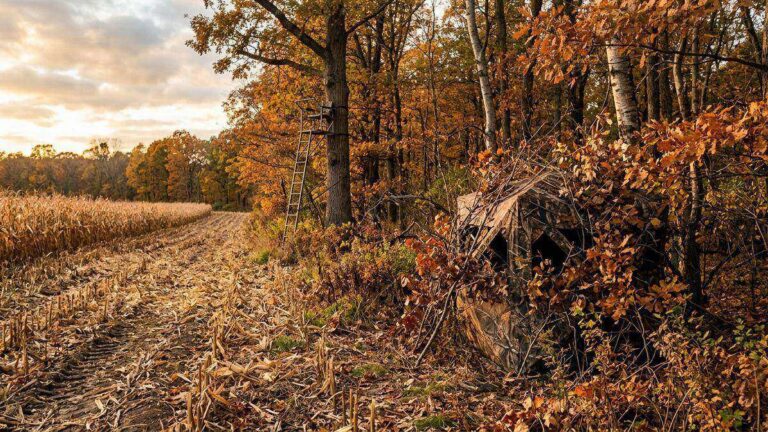
Put your plot between bedding cover and a bigger food source, not out in the open. A long, narrow plot — an hourglass or a strip along a timber edge — pulls deer through in shooting light better than a square field in the middle of a pasture. Keep your stand access downwind of the bedding, and hunt the plot only when the wind is right. A plot you burn out in the first week by hunting it wrong is worse than no plot at all.
Hang a camera on the plot the day you finish planting. A season of trail-camera data on your plot tells you which bucks use it, when, and from which direction — the intel that turns a green field into a filled tag.
From plot to freezer
Growing the deer is half the work; the season closes the loop. The plot that peaks in November lines up with the same window a straight-wall or bolt rifle earns its keep, so make sure your deer rifle is squared away before the plot matures. Habitat you build is habitat you owe something to — the same ethic the conservation groups behind our public ground have preached for decades.
When the plot does its job and you fill the freezer, the last step is the table. Our friends at Popular BBQ keep a running library of wild-game recipes that treat a plot-fed doe with the respect it earned, and Current Homesteading’s soil and planting guides translate straight across from the garden row to the plot edge.
Frequently asked questions
What is the best time to plant food plots for deer? For fall plots across most of the whitetail range, plant in late July through early August. Brassicas need 60 to 90 days to mature, so a late-July planting peaks during the late-October rut and the early-November gun season. Southern zones can push a week or two later; far-northern zones a week earlier.
What is the easiest food plot for a beginner? Cereal rye. It germinates fast, tolerates poor and acidic soil better than brassicas, and deer feed on it green all fall. You can broadcast it into lightly worked ground without heavy equipment, which makes it the forgiving first plot for a new hunter.
Do I really need a soil test? Yes. Low soil pH is the number-one reason food plots fail. Brassicas and clover want a pH near 6.5, and most untended ground sits well below that. A cheap county-extension soil test tells you how much lime and fertilizer to add so the plants can use it.
How big should a deer food plot be? A half-acre to two acres works for most properties. Smaller kill plots of a quarter to half an acre concentrate deer for a bow shot; larger feeding plots of one to two acres hold a herd through winter. Many hunters run one of each.
Can I plant a food plot without a tractor? Yes. Cereal grains and brassicas can be established with a hand spreader, a rake, and a soil test on ground cleared with a mower or sprayer. A perennial clover plot is the most equipment-friendly long-term option once the seedbed is set.
Why won’t deer use my food plot? The three usual causes are low soil pH, poor placement in the open where deer feel exposed, and overhunting the plot until the deer go nocturnal. Test the soil, tuck the plot near bedding cover, and hunt it only on the right wind.
The deer you shoot in November started as a decision you made in July. Get the dirt right this week, and the rest of the season is just showing up.

Reader Favorites
Field-to-table reference desk
From tag to table — official season dates for all 50 states, plus safe doneness temps for your harvest.
| Species | Archery | Firearm |
|---|---|---|
| Deer | Sep–Oct | Nov |
| Elk | Sep | Oct–Nov |
| Turkey | — | Apr–May |
All 50 state wildlife agencies, plus how seasons, tags and licenses work.
Find your state → Network| Doneness | Target |
|---|---|
| Rare | 125–130°F |
| Medium-rare | 130–135°F |
| Well-done | 160°F+ |
Safe pull temps for venison and steak, from Popular BBQ.
View full chart →