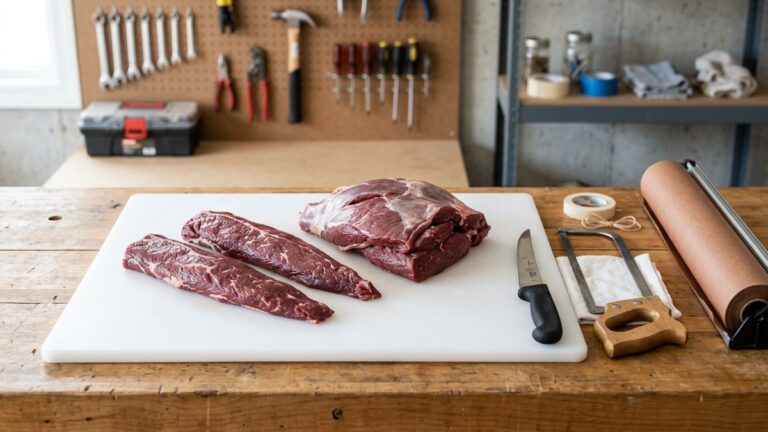
How Long to Hang a Deer: Temperature Chart and Safe Days
How long to hang a deer depends on the air: 2 to 7 days in 32°F to 40°F, and no aging hang at all once it stays above 40°F.
Originally published: October 25, 2026
Food safety note. This article is general information, not a substitute for your state’s food safety guidance. The hang times below come from university extension services and a state food safety agency, and every one of them assumes a clean, properly field-dressed deer. When the air is above 40°F, bacteria that make people sick grow quickly, so chill first and age second. Check your state wildlife agency’s current carcass and CWD rules before you move or process a deer.

How long to hang a deer is a temperature question, not a calendar question. Hanging (or aging) a deer means holding the skinned or hide-on carcass cold so the meat’s own enzymes tenderize it, and every extension service I could find draws the same line at 40°F. Below that line you have days. Above it you have a spoilage clock, and the safe move is to skin, quarter and get the meat on ice.
A deer that hangs in the garage for a week in mid-November and one that hangs for two days in an early-season heat wave are two different animals. The first one is aging; the second one is going bad. The right hang time is the one that matches the coldest steady temperature you can hold, not the number your uncle swears by.
Deer Hang Time at a Glance
- The line: 40°F. Michigan State University Extension says aging above 40°F is not recommended, and Wisconsin’s food safety division says never higher than 40°F.
- Best aging air: 32°F to 36°F (Wisconsin) or 34°F to 37°F (University of Wyoming).
- How long in that range: 2 to 3 days at most for home processing (Penn State), about 7 days for deer (Wyoming), never past 2 weeks (Wisconsin).
- Above 40°F: chill the carcass surface to 40°F or lower within 24 hours, and do not age it.
- Do not age at all: gut-shot deer, heavily shot-up deer, deer under a year old, and meat headed for sausage.

How Long to Hang a Deer by Temperature
| Air temperature | Safe hang time | Whole or quartered | What to do instead | Source |
|---|---|---|---|---|
| Below 32°F | Not a spoilage problem, but frozen days add little tenderness | Whole, hide on, to keep it from freezing | Keep the meat from freezing before rigor sets; muscle that hits 32°F within 12 hours of the kill can toughen | University of Wyoming; Wisconsin DATCP |
| 32°F to 40°F | 2 to 3 days at most (Penn State); about 7 days at 34°F to 37°F (Wyoming); never past 2 weeks (Wisconsin) | Whole, hide on, to hold down shrinkage and discoloration | This is the aging range; aim for 32°F to 36°F and cut sooner if the shed creeps toward 40°F | Penn State Extension; University of Wyoming; Wisconsin DATCP |
| 40°F to 50°F | No aging; hang only to chill, with the surface at 40°F or lower within 24 hours | Hide off; pack the cavity with bagged ice or snow | Quarter into a refrigerator, walk-in cooler or ice chest | Wisconsin DATCP; Alabama Extension; MSU Extension |
| 50°F to 60°F | No hanging without refrigeration; Wisconsin says venison will spoil hanging in warm weather | Skinned and quartered | Get it to a processor or onto ice as soon as it is tagged and registered | Wisconsin DATCP; Alabama Extension |
| Above 60°F | None; Wyoming says game harvested near 65°F should not be aged | Skinned, quartered, in the shade | Ice it in the field; above 90°F, federal food safety advice is to refrigerate perishable food within 1 hour | University of Wyoming; FoodSafety.gov |
Temperatures are the air where the carcass hangs, so go by the warmest hours, not the overnight low. Hang times assume a clean deer, field-dressed right away, that is not gut-shot. Where the sources disagree (the 32°F to 40°F row), each one is named; the shortest number is Penn State’s limit for home processing.
What Hanging a Deer Does
Hanging does two jobs, and only one of them is aging. The first job is cooling: Michigan State University Extension says the major reason for hanging a carcass is to let the meat cool further and to make butchering easier. The second job is tenderness. MSU describes aging as holding meat at 32°F to 38°F for as long as 10 days “to allow natural enzymes to tenderize the meat.”
There is also rigor mortis to wait out (the stiffening every hunter has wrestled with on a cold morning). Meat scientists Ray Field and Warrie Means at the University of Wyoming write that meat cooled at 34°F “usually returns to its original tenderness level on the third day after harvest.” So a short cold hang is not wasted time, even if you never plan to age a deer for a week.
Having worked behind the counter for over 20 years, I hear the hang-time argument every fall, and it always gets settled the wrong way: by whoever talks loudest. Let’s settle it with a thermometer instead.
Why 40°F Is the Line
FoodSafety.gov defines the temperature danger zone as 40°F to 140°F, the range where “bacteria that cause food poisoning multiply quickest,” and it says a refrigerator should run at 40°F or below. A deer hanging in 45°F air is, for food safety purposes, a very large piece of meat sitting outside the refrigerator.
Every venison source I opened agrees on that line. Penn State Extension says to hold the carcass at 40°F or below. The Wisconsin Department of Agriculture, Trade and Consumer Protection says the proper aging range is 32°F to 36°F, “never higher than 40° F.” Michigan State’s venison bulletin puts it in capital letters: AGING ABOVE 40 DEGREES F IS NOT RECOMMENDED. (When a university writes in all caps, take the hint.)
How Long Can a Deer Hang Between 32°F and 40°F?
This is where the sources split, and it is worth knowing why. Penn State’s number, 2 to 3 days at most, is written for a hunter processing at home with no control over the temperature. The longer numbers come with tighter conditions: Wyoming says deer carcasses “should be cut approximately seven days after harvest,” with aging done at 34°F to 37°F, and it says a carcass held above 40°F should be cut before those seven days are up. Wisconsin caps it at 2 weeks, and MSU allows as long as 10 days at 32°F to 38°F.

Wyoming also explains where the ceiling comes from. At 34°F and high humidity, bacterial slime usually takes 10 to 14 days to show up on the meat, and the authors say aging should be limited to two weeks because microbial growth climbs while tenderizing slows. So the 2-week number is not a goal. It is the edge of the cliff.
My pick? If your shed or garage swings above 40°F during the day, use Penn State’s 2 to 3 days and cut. If you have a walk-in cooler or a fridge that holds the mid-30s steady, a week is well inside every source above.
The Deer-Camp Rule vs. the Extension Number
Hunter tradition says hang it a week, and even the hunting press admits the folklore wobbles: Mossy Oak Gamekeeper put it this way: “Some say a week some say three.” The extension number is shorter for home setups (Penn State’s 2 to 3 days) and lands at about a week only when the air stays at 34°F to 37°F (Wyoming). The difference is the cooler. A week in a controlled cooler matches the science; a week in a garage that warms to 50°F at noon does not.
Remember, Wyoming adds one more wrinkle: swings such as 65°F days and 30°F nights speed up aging and shorten the recommended time. A shed that bounces around is aging the deer faster than the calendar says.

The process usually involves removing the entrails, washing the cavity if needed, and keeping the meat at a steady cool temperature (ideally 34–40°F) for a few days to improve flavor and texture. Image courtesy of the Montana Wildlife Federation
How Long Can a Deer Hang at 50 Degrees?
For aging, it cannot. Wisconsin’s food safety division says that when the air is over 40°F, harmful bacteria grow quickly, and it tells hunters to chill the carcass surface to 40°F or lower within 24 hours and to consider packing the cavity with ice or snow sealed in plastic bags. Its warm-weather flyer is blunt: “Venison will spoil if it hangs without refrigeration in warm weather.”
So is 50 degrees too warm to hang a deer? Yes, unless the hanging happens inside a cooler. At 50°F the plan is to skin it, quarter it and get the meat cold, which is the same advice Alabama Extension gives for early archery seasons and warm southern hunts.
Wyoming’s research shows why the warm hang is tempting. Aging at 65°F for three days gave the same tenderizing as two weeks at 34°F. Sounds like a shortcut, right? It is not, because the same authors say game harvested near 65°F “should not be aged” at all. Tender and spoiled is still spoiled.
Hide On or Hide Off?
Hair is insulation, which is great for the deer and lousy for cooling. Alabama Extension’s rule of thumb for deer-sized animals is to remove the hide if temperatures exceed 40°F, and to leave it on in extremely cold weather to minimize freezing. Wyoming says to skin the carcass if the temperature is expected to be above freezing the first night after harvest.
In the aging range, the hide earns its keep. Wisconsin says to leave the skin on during cold aging “to hold down shrinkage and avoid discoloration,” and Wyoming says leaving the hide on in cold weather helps prevent cold shortening (the toughening that happens when muscle chills too fast) and keeps the carcass from freezing.
Hanging a Deer Below Freezing
A hard freeze sounds ideal, and for bacteria it is. For tenderness it is not. Wyoming says that if the carcass freezes while hanging, little additional tenderization happens, because enzyme action is very slow at freezing temperatures. Worse, cold shortening “will occur if the internal muscle temperature drops to 32°F within 12 hours after the kill.” Wisconsin’s version: hold the carcass at 40°F or less, but avoid freezing it before rigor.
So in single digits, leave the hide on, hang it somewhere the wind cannot reach, and do not count frozen days as aging days.
No Cooler? Do This Instead
Most of us do not own a walk-in, and that is fine. Wisconsin’s list for warm weather is a large cooler full of ice or snow, with cut meat stored in a cooler of ice or dry ice. Alabama Extension adds two tricks: an ice, water and salt slurry to cool meat down fast, and insulated cooler bags when you are far from a cooler. It also warns that plastic seals in heat, so meat should be fully cooled before it goes into a plastic bag.
Keep the carcass out of the sun and off the hood, too. Wisconsin says not to tie a deer across the hood or roof or put it in a trunk, and Alabama says direct sunlight can heat a carcass quickly even when the air feels cool. (Yes, the truck-hood trophy photo has to happen somewhere else.)
When Not to Age a Deer at All
Some deer should go straight to the knife. Wyoming’s do-not-age list: a deer harvested in warm weather and not chilled rapidly, a severely stressed animal, a deer with extensive gunshot damage, or one under a year old. Wisconsin adds that you should age a deer only if it has been properly handled, is clean and is not gut-shot. If the blood trail told you it was a gut hit, our deer blood color chart explains what that green or brown sign means, and that deer is not one to hang.
Meat headed for the grinder does not need it either. Penn State and the National Center for Home Food Preservation both say aging is not necessary for sausage.
If you sent a sample for chronic wasting disease, the hang is the easy part. Our chronic wasting disease testing guide says results typically take one to three weeks, and it says to freeze the meat and hold off on mixing carcasses until the result comes back.
After the Hang: Cut, Wrap and Cook
When the hang is done, our guide to how to process a deer at home covers skinning, quartering and butchering. Once it is cut, Penn State says to use unfrozen meat within two or three days, and properly wrapped game meat keeps in the freezer for 9 to 12 months (the National Center for Home Food Preservation says to freeze it at 0°F or below). For cooking temperatures, cuts and the CWD question, our venison guide lays out what USDA and the extension services each recommend.
Most of you process your own deer, start to finish.
Frequently Asked Questions
What is the 7-day deer rule?
No extension publication I opened calls it a rule, but the University of Wyoming does say deer carcasses should be cut approximately seven days after harvest when aged at 34°F to 37°F. If the carcass was held above 40°F, Wyoming says to cut it before the seven days are up.
What happens if you do not hang a deer before butchering?
Ground meat loses nothing, since Penn State says aging is not necessary for sausage. Steaks and roasts give up some tenderness, because Wyoming found meat cooled at 34°F usually does not return to its original tenderness until about the third day after harvest.
What should you do right after killing a deer?
Field-dress it immediately and start cooling it. Penn State says to cool the carcass to 35°F to 40°F quickly and to prop the cavity open or hang the carcass so air moves through it. Wisconsin suggests spreading the rib cage to help it cool faster.
Can a deer hang overnight at 50 degrees?
Not to age. If you have no other choice for one night, Wisconsin’s numbers are the floor: ice or snow in sealed bags packed in the cavity and the carcass surface at 40°F or lower within 24 hours. Alabama Extension adds: take the hide off once it is above 40°F. Then get the meat into a cooler or to a processor.
Do you hang a deer head up or head down?
None of the extension sources in this article sets a rule on head up or head down; they care about the temperature, the shade and the air moving around the carcass. Hang it the way your gambrel and your skinning plan work best.
The thermometer settles more deer-camp arguments than any uncle ever has. Hang it cold, cut it when the numbers say so, and if the garage hits 50°F by lunch, the deer is telling you it wants to be in a cooler, not on a gambrel.
Sources: Penn State Extension, “Proper Care and Handling of Venison from Field to Table”; Wisconsin Department of Agriculture, Trade and Consumer Protection, “Caring for Venison in Warm Weather”; University of Wyoming Agricultural Experiment Station, Field and Means, B-513R; Michigan State University Extension, “Michigan Venison 2002” (copy hosted by Bay County, Michigan); Alabama Cooperative Extension System, “Venison: The Best Meal You’ll Ever Have”; National Center for Home Food Preservation, “The Hunt is On: Know the Basics of Venison Preservation”; FoodSafety.gov, “4 Steps to Food Safety”; Mossy Oak Gamekeeper, “Aging Venison: How Long To Hang Your Deer”.
Reader Favorites
Field-to-table reference desk
From tag to table — official season dates for all 50 states, plus safe doneness temps for your harvest.
| Species | Archery | Firearm |
|---|---|---|
| Deer | Sep–Oct | Nov |
| Elk | Sep | Oct–Nov |
| Turkey | — | Apr–May |
All 50 state wildlife agencies, plus how seasons, tags and licenses work.
Find your state → Network| Doneness | Target |
|---|---|
| Rare | 125–130°F |
| Medium-rare | 130–135°F |
| Well-done | 160°F+ |
Safe pull temps for venison and steak, from Popular BBQ.
View full chart →