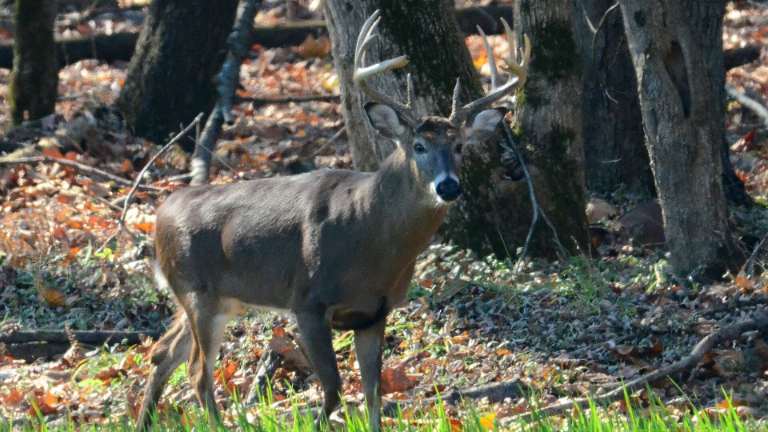
Deer Rut Dates by State: What the Agency Data Says
There is no national peak of the rut. State agencies that publish their own conception data disagree by weeks, and this is what each one says.
Last updated: October 9, 2026 · Originally published September 16, 2026
There is no national peak of the rut. State wildlife agencies that publish their own conception-date data put peak breeding anywhere from July 22 in south Florida to February 8 in southwest Alabama. The familiar “November 7 to 15” window is real for Pennsylvania, New York, Virginia and central North Carolina — and by published agency data, not one square mile of six Deep South states peaks inside it.
What the agency data actually shows
- Photoperiod sets the timing. Weather and moon do not. A peer-reviewed test found moon phase missed conception dates by an average of 16 days. Pennsylvania’s median conception date sat at November 13 no matter where the full moon fell.
- Latitude runs backward in at least three states. In Mississippi the northern Delta breeds first and the southern coast breeds last. In North Carolina the coast is earliest and the mountains are latest.
- The reason is 20th-century restocking, not daylight. Alabama’s own agency says it plainly: “The genetics determine the rut of those deer to this day.”
- Georgia’s famous rut map is a roadkill map. It is built from 45,811 deer-vehicle collisions and was validated against conception dates in three of 159 counties.
- Two states publish decades-old data as current guidance. South Carolina’s 2024 harvest report labels its own breeding data 1987–1994. Texas Parks and Wildlife’s live rut page is a 1996 document.
- Ten states publish no conception-date data at all — including Ohio, Michigan, Wisconsin, Minnesota and Iowa.

Why I am not publishing a 2026 rut forecast
I am based in Birmingham, Alabama, where the rut question comes up every fall. Here is the problem. No agency publishes a forecast, and the published evidence says one would be meaningless anyway. Let’s look at why.
Peak conception in a given area is remarkably stable from year to year. Mississippi State University and Mississippi researchers analyzing 851 wild does across ten populations found that annual population means varied by only four days. North Carolina’s wildlife commission states it directly: “Little variation exists in peak breeding activity from one year to the next within a given area.”
What varies year to year is deer movement — when you see them — and that is a different question from when does are bred. Louisiana’s wildlife department is the only agency I found that says so on the page where hunters actually look: “peak breeding times are not necessarily peak buck movement times… research has shown that peak buck movement is one to two weeks before peak breeding.”
So this page gives you dated, sourced breeding data for your state (with the sample sizes and the publication dates), and then tells you plainly which parts of the popular rut calendar the science supports.


Whitetail rut dates by state
Every date below comes from a state wildlife agency’s own publication or a peer-reviewed study, with its sample size, its data years and the date the agency published it. The currency column matters: several widely cited state maps are ten to thirty years old and the agencies do not say so on the page.
| State | Peak breeding / conception | Spread | Method | Sample | Data years | Agency | Currency |
|---|---|---|---|---|---|---|---|
| Alabama | Nov 10 – Feb 8, six county bands | 90 days | Stocking history, herd health, fetal collections | Not published | Not published | ADCNR | Current (8/12/26) |
| Arkansas | Oct 28 – Dec 14 by region | 47 days | Not published | Not published | Not published | AGFC | 2018 |
| Florida | Jul 22 – Mar 3, mean conception | 224 days | Breeding chronology / fetal aging | Not published | Since 2009 | FWC | 2018 |
| Georgia | Oct 13 – Dec 28, county peak weeks | 76 days | Deer-vehicle collisions (proxy) | 45,811 collisions | 2005–2012 | GA DNR WRD | 2015 |
| Louisiana | Sep 26 – Feb 26, eleven bands | 153 days | Fetal measurements | Varies by area | Since 2006 for newer areas | LDWF | 2014 |
| Mississippi | Nov 30 – Feb 6, ten bands | 68 days | Herd health checks / fetal aging | Not published | 20-plus years | MDWFP | 2016 |
| North Carolina | Oct 31 – Dec 5, five zones | 35 days | Roadkill and late-season harvest | 1,776 samples | Through May 2025 | NCWRC | Current (2025) |
| Oklahoma | Nov 13 mean conception | Not published | Fetal aging | 12 does | 1972 | Dunbar 1976 | Obsolete |
| Pennsylvania | Nov 13 median adult; Nov 25 doe fawns | Not published | Fetal aging of road-killed does | 3,507 / 6,000-plus | 1999–2007 | PGC + Penn State | Aging, authoritative |
| South Carolina | Oct 30 statewide average | Not published | Fetal aging | Not published | 1987–1994 | SCDNR | Obsolete data, current report |
| Texas | Sep 30 – Dec 24, eight ecoregions | 85 days | Fetal aging | 2,436 does, 16 areas | 3 years, pre-1996 | TPWD | 1996, still live |
| Virginia | Nov 16 peak conception | Not published | Back-calculated from fawning | Not published | Not published | VA DWR | Current (2025) |
| Indiana | County estimates exist in Ch. 9 | Not extracted | Deer-vehicle collisions | Not extracted | Through 2019 | IN DNR | 2019, partial |
| New York | Mid-November (range Oct–Jan) | Not published | Not published | Not published | Not published | NY DEC | Range statement only |
| Missouri | “Most breeding in November” | Not published | Not published | Not published | Not published | MDC | No study found |
| Ohio | Not published | — | — | — | — | ODNR | No data published |
| Michigan | Not published | — | — | — | — | MI DNR | No data published |
| Tennessee | Not published | — | — | — | — | TWRA | No data published |
| Kentucky | Not published | — | — | — | — | KDFWR | No data published |
| West Virginia | Not published | — | — | — | — | WVDNR | No data published |
| Wisconsin | Not published | — | — | — | — | WI DNR | No data published |
| Minnesota | Not published | — | — | — | — | MN DNR | No data published |
| Iowa | Not published | — | — | — | — | IA DNR | No data published |
| Kansas | Not published | — | — | — | — | KDWP | No data published |
| Illinois | Nov 10 mean conception (adults Nov 8, yearlings Nov 11, doe fawns Dec 2) | Not published as a spread; SE 0.28 days on the mean | Fetal aging | 3,884 does, 4,781 fetuses | 2003–2013 | Green et al. 2017, INHS | 2017, northern Illinois only |
Download the full dataset (CSV) — 25 states with peak dates, methods, sample sizes, data years, agency, document title, source URL, publication date and a currency flag.
When is the rut in Georgia?
Georgia’s Department of Natural Resources publishes county peak weeks running from October 13–19 in a handful of south Georgia counties to December 22–28 in Seminole County — about eleven weeks of spread inside one state. Metro Atlanta counties fall in the November 10–16 band; the northeast mountains run later, November 24–30.
What almost nobody tells you: it is not a conception map. The Georgia map is built from the peak week of deer-vehicle collisions in each county — 45,811 collision records from 2005 to 2012, published by Stickles and colleagues in 2015. DNR’s own page explains that researchers found a strong correlation between collision peaks, conception dates and hourly movement rates, and the study validated the proxy against conception data in three of Georgia’s 159 counties. The state’s own caveat: counties with fewer than 100 collisions in the sample period are flagged as low accuracy.
Set that beside Louisiana’s published statement that peak buck movement runs one to two weeks before peak breeding, and there is an unresolved question sitting in plain sight: if a collision peak tracks movement, the most-cited rut map in the Southeast may be systematically early relative to conception. I am not asserting that it is. I am reporting that two agencies’ published statements are in tension, and nobody has reconciled them.
When is the rut in Texas?
Texas Parks and Wildlife publishes real fetal-aging data from 2,436 does across 16 study areas — the largest published dataset in the South. Peak breeding dates by ecoregion:
| Ecoregion | Breeding date range | Peak | Pregnancy rate |
|---|---|---|---|
| Gulf Prairies and Marshes | Aug 24 – Nov 25 | Sep 30 north / Oct 31 south | 92% |
| Post Oak Savannah | Sep 30 – Jan 16 | Nov 10–11 | 92% |
| Pineywoods | Oct 21 – Jan 5 | Nov 22 north / Nov 12 south | 96% |
| Rolling Plains | Oct 8 – Dec 30 | Dec 3 north / Nov 20 south | 97% |
| Edwards Plateau | Oct 9 – Jan 30 | Nov 7 east / Nov 24 central / Dec 5 west | 90% |
| Cross Timbers | Oct 13 – Dec 17 | Nov 15–17 | 95% |
| Trans-Pecos | Nov 4 – Jan 4 | Dec 8 | 81% |
| South Texas Plains | Nov 9 – Feb 1 | Dec 16 east / Dec 24 west | 95% |
The full Texas breeding range spans August 24 to February 1. One caveat the agency does not print on the page: this study was published in 1996, and it is still the live TPWD rut page in 2026.
When is the rut in Ohio, Michigan, or Wisconsin?
I cannot tell you, and neither can they.
Ohio’s Department of Natural Resources publishes that “courtship activities among deer begin in mid-October” and a gestation range of 187 to 222 days. It publishes no peak breeding or conception date. Michigan’s DNR deer pages contain no rut date at all. Tennessee publishes only a 199-day gestation figure. I found no published conception-date data for West Virginia, Kentucky, Wisconsin, Minnesota, Iowa or Kansas either. Illinois is the exception, and it took a journal to find it — see below.
That is ten states with no agency rut date — several of them among the most-hunted whitetail states in the country. Every rut calendar that gives you a confident Ohio or Michigan date is giving you an inference, not agency data. I would rather print the gap.
Two partial leads worth knowing: Indiana’s 2019 deer report contains county-level peak breeding estimates derived from deer-vehicle collisions in Chapter 9 — a second collision-based map alongside Georgia’s, which I have not yet extracted. And New York’s DEC states a range: “The breeding season (or rut) for white-tailed deer in New York runs from October to January, with peak activity occurring in mid-November.”
The rut in the North: what the best dataset says
Pennsylvania has the strongest northern data in the country, and two independent efforts agree.
The Pennsylvania Game Commission aged more than 6,000 road-killed does between 2000 and 2007: “Nine out of 10 does were bred from mid-October to mid-December. And the peak of the rut occurred in mid-November.” Adult does were 91 percent pregnant; doe fawns 26 percent, with their breeding peaking from late November into February.
The Penn State Deer-Forest Study, working from 3,507 road-killed does collected 1999–2006, put the median conception date at November 13 for adult does and November 25 for doe fawns.
Virginia’s Department of Wildlife Resources puts its peak conception at November 16, back-calculated from fawning dates on a roughly 200-day gestation. North Carolina’s central zone lands at November 15.
And the Midwest has one dataset that rivals Pennsylvania’s, published in a journal rather than on an agency website, which is why most rut calendars miss it. Green and colleagues aged 4,781 fetuses from 3,884 does taken across fifteen northern Illinois counties between 2003 and 2013. Mean conception was November 10 — November 8 for adult does, November 11 for yearlings, and December 2 for doe fawns, the same fawn lag Pennsylvania records. It covers northern Illinois only, and the Illinois Department of Natural Resources publishes nothing comparable itself.
So the mid-November peak is real — for the Mid-Atlantic and Northeast. It is the extrapolation of that number to the rest of the whitetail range that fails.
Why southern rut dates run backward
The naive model says higher latitude means an earlier, tighter rut. It works across the country as a whole. It fails inside individual southern states, and the agencies know exactly why.
Mississippi: the northwestern Delta counties breed earliest (November 30 – December 12) and the southeastern piney woods latest (January 24 – February 6). North is early, south is late — the opposite of the latitude rule.
North Carolina: the coastal Southeastern zone peaks October 31; the mountainous Western zone peaks December 5. Five weeks apart, running coast-early and mountain-late.
The explanation the agencies give is not daylight. It is history. Alabama’s Department of Conservation states it verbatim on its current rut map: the state “underwent an extensive white-tailed deer restocking program during the middle of the 20th century. Deer stocked were from several states which not only brought great deer to Alabama but their genetics as well. The genetics determine the rut of those deer to this day.” Alabama’s restocked deer came from Arkansas, Georgia, Michigan, North Carolina, Ohio, Texas and Wisconsin. Louisiana says the same in fewer words: “We estimate deer breeding periods primarily using the genetics of does.” Florida credits daylength, latitude, mild climate, and genetics from 1940s–60s restocking.
There is peer-reviewed support, and it is more specific than the popular retelling. Sumners and colleagues (2015) compared six pairs of adjacent southern populations whose peak breeding dates differed by an average of 35 days against four control pairs differing by no more than two days. In the divergent-date pairs, maternal (mitochondrial) DNA differentiation was far higher — Fₛ = 0.408 versus 0.140 for the control pairs (P = 0.03) — while biparentally inherited microsatellite markers showed no matching difference (0.047 versus 0.028, P = 0.200), which the authors read as evidence that bucks disperse freely between these populations and still fail to pull the breeding dates together. Their stated conclusion is a maternal genetic effect on the timing of breeding, “likely maintained by female philopatry.” Restocking is offered as a hypothesis for where that maternal structure came from — in their words, “a genetic legacy of restocking efforts and the recovery of remnant localized populations.” Note what the study does not say: because it deliberately compares adjacent populations, latitude is held roughly constant by design, so the paper is not positioned to rule latitude out as a driver of southern rut variation generally. Abstract text quoted above is the publisher-deposited version retrieved from Crossref (DOI 10.1002/jwmg.954; J. Wildl. Manage. 79(8):1213–1225). The full text is paywalled, so sample sizes, the number of microsatellite loci and the method used to establish breeding dates are not stated here — I did not reconstruct them.
The practical version: in the South, your rut date tracks the history of where your state bought its deer far more closely than it tracks latitude — and that is the state agencies’ own explanation, not mine.
Florida has the widest rut in America, and it is not close
Florida’s Fish and Wildlife Conservation Commission publishes mean conception dates by site running from July 22 in extreme south Florida to March 3 in the northwest and the Green Swamp Basin — a 224-day spread inside one state. FWC states that biologists have documented breeding in every month except May, and that within a single area conception spans “vary from 9 to 110 days, with an average of 45 days.”
Runner-up is Louisiana at roughly 153 days of banded peaks, then Texas at 85 days of published peaks. Alabama runs about 90 days band to band, Mississippi 68, Georgia 76 by collision proxy, North Carolina 35.
Does the moon control the rut?
No, and this is one of the better-tested questions in deer biology.
The central study is Dye and colleagues (2012) in the Wildlife Society Bulletin: 83 captive deer tracked from 1976 to 2003, plus 851 wild females from ten Mississippi populations sampled 1991–2004. The finding, in the authors’ words: “Moon phase did not predict accurately conception date for individuals or populations of deer.” The mean deviation from moon-predicted dates was 16 days. Their recommendation was that managers “rely on local reproductive data.”
The Penn State Deer-Forest Study reached the same conclusion from a different direction: “No matter the date of the full moon the median date of the rut simply bounced around 13 November for adults and 25 November for fawns. There is no relationship between the rut and the moon.”
The Pennsylvania Game Commission puts the arithmetic bluntly: the rut occurs in mid-November, but the “rutting moon” varies from late October to late November. North Carolina’s commission states that estrus is triggered by shortening day length “rather than weather events, including moon phase.”
I looked for published research finding a real effect on rut timing and did not find any. The weak and mixed effects in the literature are on movement and activity, not conception dates.
Does cold weather bring on the rut?
It brings on deer movement, which is not the same thing, and the agencies are careful about the distinction even when the hunting press is not.
Mississippi State’s Deer Lab: “Changing weather can stimulate deer movement, but a drop in temperature does not influence when the breeding season occurs.” Texas Parks and Wildlife makes the argument from geography — whitetails breed in tropical climates where there is no cold front to trigger anything — and notes that “bucks, like hunters, have a tendency to move around during cool weather.”
The movement evidence is thinner than either side of the argument admits. Penn State researchers testing a cold front against GPS-collared deer found no difference in speed or distance before, during or after — but that test involved seven deer, which is not enough to settle anything. An Auburn study on a South Carolina property found “varied” results with activity at all hours during the rut. I am reporting the sample size because the conclusion depends on it.
The rut phases are hunting-media vocabulary, not biology
Read enough rut content and you will meet a seven-stage calendar: pre-rut, seeking, chasing, tending, lockdown, post-rut, second rut. Here is what I found when I went looking for those terms in agency and university sources.
“Seeking,” “chasing,” “tending” and “lockdown” appear in none of them. Texas Parks and Wildlife, North Carolina’s commission, Louisiana, Mississippi, Florida, Alabama and Mississippi State’s Deer Lab use two or three terms only: pre-rut, peak rut or peak breeding, and second rut. The multi-phase calendar comes from hunting media, and it may still be useful shorthand for what you observe from a stand — but it is not a biological taxonomy and it should not be presented as one.
The “second rut” is real, with a caveat about the number everyone quotes. Mississippi State documents a small secondary peak of breeding “3–4 weeks later, due to does that had to recycle and fawns that mature their first winter.” The estrous cycle is published as 21 to 30 days, not the round 28 that gets repeated — and Mississippi State’s own two pages disagree with each other, one saying “roughly 28-day cycle” and the other “21-30 days.” I am citing the range. Estrus itself lasts 24 to 48 hours, and up to seven cycles have been observed in research pens.
Pennsylvania’s data gives the mechanism: doe fawns were 26 percent pregnant, with their breeding peaking from late November into February. A meaningful share of a “second rut” is first-year does coming into estrus for the first time.
Does a better buck-to-doe ratio shift the rut?
This one is contested, and I am not going to pretend otherwise.
Mississippi State’s Deer Lab states it has “documented shifts of up to 30 days in peak breeding date due to improvement in buck to doe ratio and buck age structure.” No citation accompanies that claim on the page.
Against it: Diefenbach and colleagues (2019) in the Journal of Wildlife Management examined Pennsylvania across the 2002 antler-restriction change, during which bucks aged 2.5 years and older rose from 41,853 to 54,064 statewide. Their finding: “We found no evidence of any change in the timing or variability of date of conception, productivity, or offspring sex ratio.”
A statewide natural experiment found nothing; a university lab reports a 30-day effect without a citation. Texas Parks and Wildlife offers a mechanism that would produce a longer tail rather than a shifted peak: where there are few bucks, “a doe may not encounter a buck when she is first receptive and may not be bred until one of her later cycles.” I report the conflict and leave it open.
New for the 2026 season
Two states have made rut-period regulation changes that are already published:
- North Carolina added an antlered-deer early season on August 22–23, 2026 in all CWD Management Areas, and in the Northwestern CWD area — Forsyth, Stokes, Surry, Wilkes and Yadkin counties — moved blackpowder a week earlier to October 31 and gun season a week earlier to November 14. The stated rationale is to shift buck harvest earlier and reduce young-buck dispersal before the rut. Worth setting against NCWRC’s own 2025 data: the Northwestern zone’s peak conception is November 25, and Stokes County’s is November 14 — the day the gun season now opens.
- Delaware adopted emergency CWD regulations effective August 17, 2026, including a statewide ban on urine-based buck lures because prions are shed in bodily fluids, an attractant ban in the Sussex County CWD zone, and mandatory check-in at two stations during the November 13–22 firearm season.
- Missouri cut the nonresident buck limit from two to one, moved youth season a week earlier to October 24–25, eliminated antler point restrictions in the final 18 counties, and set mandatory CWD sampling for November 14–15, 2026 in St. Charles, Lincoln and Warren counties.
How to use this
Now, here is the practical part.
- Find your state’s peak conception date above, and note the currency flag. If your state is one of the ten with no data, use your nearest neighbor’s with the understanding that you are inferring, especially in the South where neighboring populations can differ by three weeks.
- Hunt the week before it, not the week of it. Louisiana’s guidance is the one to internalize: peak buck movement runs one to two weeks ahead of peak breeding, because during peak breeding bucks are with does rather than looking for them.
- Ignore the moon and the forecast for planning purposes. Use them to decide whether you enjoy sitting; do not use them to pick your week.
- Expect a small secondary window 21 to 30 days after the peak, driven substantially by doe fawns and does that did not conceive on the first cycle.
Pair this with your state’s actual season structure — my deer season dates by state hub has the current openers — and with trail camera patterning ahead of the season.
Frequently Asked Questions
Is there a national peak of the deer rut?
No. State wildlife agencies that publish their own conception-date data put peak breeding anywhere from July 22 in south Florida to February 8 in southwest Alabama. The familiar “November 7 to 15” window is real for Pennsylvania, New York, Virginia and central North Carolina, but by published agency data, not one square mile of six Deep South states peaks inside it.
Does the moon affect when the rut happens?
No, not by the evidence. A peer-reviewed test found moon phase missed actual conception dates by an average of 16 days. Pennsylvania’s median conception date sat at November 13 no matter where the full moon fell that year.
Does the rut always move later as you go south?
No. Latitude runs backward in at least three states: in Mississippi, the northern Delta breeds first and the southern coast breeds last; in North Carolina, the coast is earliest and the mountains are latest. Agencies attribute this to 20th-century restocking genetics, not daylight.
How many states publish real conception-date data for the rut?
Ten states publish none at all, including Ohio, Michigan, Wisconsin, Minnesota and Iowa. Of the states that do publish data, some of it is decades old: South Carolina’s 2024 harvest report labels its own breeding data 1987–1994, and Texas Parks and Wildlife’s live rut page is a 1996 document.
Final Thoughts
Remember, the rut in your county was set decades ago by daylight and by whichever trucks brought the deer in. It does not move for the moon, and it does not move for a cold front. Find your state’s published date, hunt the week ahead of it, and do not let a calendar built for Pennsylvania tell you when to sit in Alabama.
A note on sources. Every date comes from a state wildlife agency publication or a peer-reviewed study, read directly and recorded with its sample size, data years and publication date. Where an agency publishes no conception data, this page says so rather than inferring a date from a neighboring state. Hunting media were read to identify claims worth checking, and were not used as sources for any date. Every agency named in the table was loaded and read on 2 September 2026, and each state row links to the exact page or document that was checked, including the states that publish nothing — so a “not published” row here means I went to that agency and came back empty, not that I did not look. Where a state agency publishes no conception data but a peer-reviewed study of that state does, the study is used and labeled as such: Illinois and Oklahoma are the two cases. Researched and written by James Nicholas, edited by the Popular Outdoorsman team.
Sources
- Green, Kelly, Satterthwaite-Phillips, Manjerovic, Shelton, Novakofski and Mateus-Pinilla, 2017, “Reproductive characteristics of female white-tailed deer (Odocoileus virginianus) in the Midwestern USA,” Theriogenology 94:71–78 (Illinois Natural History Survey; 4,781 fetuses, 2003–2013)
- Dunbar, 1976, “Breeding season of white-tailed deer in eastern Oklahoma,” Proceedings of the Oklahoma Academy of Science 56:24–25 (12 does, collected 1972)
- Georgia DNR, Rut Map; Stickles et al. 2015, “Using Deer-vehicle Collisions to Map White-tailed Deer Breeding Activity in Georgia,” Journal of the Southeastern Association of Fish and Wildlife Agencies 2:202–207
- Texas Parks and Wildlife, The Rut in White-tailed Deer (Traweek, Wardroup, Williams and Young, 1996)
- Alabama DCNR, Alabama Rut Map (file dated August 12, 2026) and Outdoor Alabama on rut map methodology
- Mississippi MDWFP, Deer Breeding Date Map (February 2016)
- Louisiana LDWF, Estimated Deer Breeding Periods
- Florida FWC, Statewide Rut Map and Statewide Deer Breeding Chronology
- NC Wildlife Resources Commission, Estimated Peak Conception Dates (updated 2025)
- PA Game Commission, When is the Rut in Pennsylvania and Penn State Deer-Forest Study
- Dye, M.P., S. Demarais, B.K. Strickland, P.D. Jones, C.G. McDonald and D.F. Prochaska, 2012, “Factors affecting conception date variation in white-tailed deer,” Wildlife Society Bulletin 36(1):107–114, DOI 10.1002/wsb.98
- Diefenbach, D.R., G. Alt, B.D. Wallingford, C.S. Rosenberry and E.S. Long, 2019, “Effect of male age structure on reproduction in white-tailed deer,” Journal of Wildlife Management, DOI 10.1002/jwmg.21712
- Sumners, J.A. et al., 2015, “Variable breeding dates among populations of white-tailed deer in the southern United States: The legacy of restocking?” Journal of Wildlife Management, DOI 10.1002/jwmg.954
- Mississippi State University Deer Ecology and Management Lab; SCDNR 2024 Deer Harvest Report; Virginia DWR; Dunbar 1976, Proceedings of the Oklahoma Academy of Science 56:24–25
- NCWRC CWD season changes, June 26, 2026; Delaware DNREC emergency regulations, August 17, 2026
Related on Popular Outdoorsman: Deer season dates by state · Food plots for deer · Patterning velvet bucks on trail camera · Best hunting rangefinders
Across the Brand Avalanche network: Popular BBQ’s wild game recipes · Current Homesteading on canning and preserving your harvest
Last verified: August 19, 2026. This page is reviewed each August before the season and updated whenever a state publishes new conception data. Ten states currently publish none; if yours starts, tell me and I will add it.

Reader Favorites
Field-to-table reference desk
From tag to table — official season dates for all 50 states, plus safe doneness temps for your harvest.
| Species | Archery | Firearm |
|---|---|---|
| Deer | Sep–Oct | Nov |
| Elk | Sep | Oct–Nov |
| Turkey | — | Apr–May |
All 50 state wildlife agencies, plus how seasons, tags and licenses work.
Find your state → Network| Doneness | Target |
|---|---|
| Rare | 125–130°F |
| Medium-rare | 130–135°F |
| Well-done | 160°F+ |
Safe pull temps for venison and steak, from Popular BBQ.
View full chart →