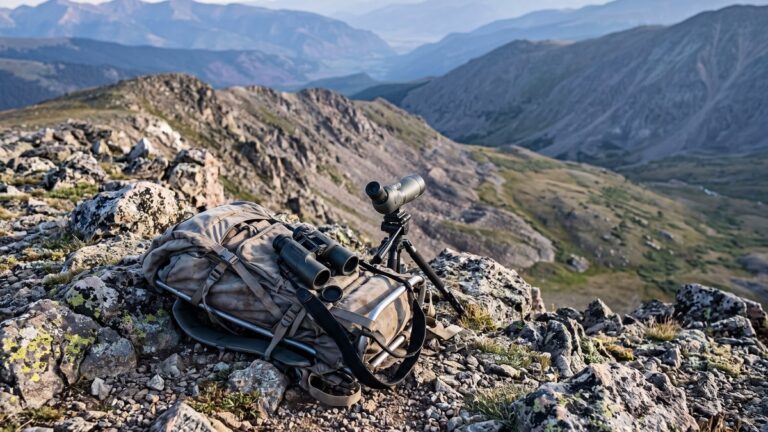
Bezoar Ibex Comeback: How Wild Giants Plans to Restore Them
Bezoar ibex are the wild goats of the Caucasus and ancestor of the domestic goat, and Georgia has a few hundred left in two mountain areas.
Originally published: October 31, 2026
Sponsor note. Wild Giants Conservation is a sponsor of our Giving Thanks giveaway. Safety and legal note. This article is general information about a wildlife species and a conservation group, not hunting or legal advice. Hunting rules for ibex in the United States and abroad change by season and by license, so check the wildlife agency that issues the tag before you plan a hunt.

The bezoar ibex (Capra aegagrus, also called the bezoar goat or Persian ibex) is a wild mountain goat. A 2022 survey report by the Georgian conservation group NACRES, published by the United Nations development agency, UNDP, says it survives in Georgia only in Tusheti and Khevsureti, high on the Greater Caucasus. Georgia lists it as Critically Endangered, so hunting one there is not on the table.
Most hunters know the American version of this story, where elk, bighorn sheep and wild turkeys came back because hunters paid for the work. The Caucasus never got that rescue, and Georgia’s ibex, West Caucasian tur and red deer are down to remnant herds, with no resident leopards left. A small nonprofit called Wild Giants Conservation wants to change that by breeding animals, releasing them, and building local income around them. The right way to judge a plan like that is by the species it names, the numbers behind them, and where the money is supposed to come from.
Bezoar Ibex at a Glance
- What it is: A wild goat of the Caucasus and the Middle East, and the wild ancestor of every domestic goat (Naderi and others, 2008).
- How many in Georgia: About 477 in the 2021 survey, 363 in Tusheti and 114 in Khevsureti. Wild Giants gives 300 to 450 as of 2022.
- Official status: Critically Endangered on Georgia’s Red List; Near Threatened worldwide on the IUCN Red List (2020).
- The plan: Wild Giants bought a 305-acre site in Georgia and plans a breeding center that will start with bezoar ibex.
- The American herd: New Mexico released Persian ibex in the Florida Mountains near Deming in 1970 and held the first hunt in 1974.

The Six Species Wild Giants Wants Back
Wild Giants calls its project area the Caucasus Ecoregion and names six animals on its Caucasus project page. The bezoar ibex comes first, because it is the one the breeding center will start with. Here is where each one stands in Georgia, on Wild Giants’ own species pages and on Georgia’s official Red List.
| Species | Wild population in Georgia (Wild Giants figure) | Georgia Red List, 2014 | Hunting in Georgia | ||
|---|---|---|---|---|---|
| Bezoar ibex | |||||
| Capra aegagrus | 300 to 450 (2022); Tusheti about 300, Pshav-Khevsureti about 100, Adjara extinct | Critically Endangered | Protected since 1982 (2022 survey report); poaching is the main threat | ||
| East Caucasian tur | |||||
| Capra cylindricornis | 6,500 | Vulnerable | Prohibited (Wild Giants) | ||
| West Caucasian tur | |||||
| Capra caucasica | 12 (Georgian wildlife agency, 2025, as cited by Wild Giants) | Endangered | Prohibited (Wild Giants) | ||
| Armenian mouflon | |||||
| Ovis gmelini | 0 in Georgia; 1,900 to 2,000 across the Caucasus | Not on the 2014 list (searched the decree for “Ovis”: 0 hits) | None left in Georgia; protected in most of its remaining range | ||
| Persian leopard | |||||
| Panthera pardus tulliana | No resident breeding population; 40 to 60 across the Caucasus | Critically Endangered (listed as Panthera pardus) | Prohibited; fully protected (Wild Giants) | ||
| Caspian red deer | |||||
| Cervus elaphus maral | 400 to 600 (2022) | Critically Endangered (listed as Cervus elaphus) | Prohibited in protected areas (Wild Giants) |
Population figures are the estimates on each Wild Giants species page, with the year it gives where it gives one. The Red List column is Georgia’s national list, adopted by Government of Georgia Resolution No. 190 of February 20, 2014, which lists the leopard and red deer at the species level. The hunting column quotes the Wild Giants species pages, except the bezoar ibex row, which comes from the 2022 survey report because the Wild Giants ibex page does not state a hunting rule.
What Is a Bezoar Ibex?
A bezoar ibex is the wild goat, plain and simple, and every barnyard goat in America descends from it. A 2008 study in the Proceedings of the National Academy of Sciences compared 473 wild bezoar samples with domestic goats and found every mitochondrial DNA group of modern domestic goats in the wild bezoar too. The authors traced almost all domestic goats to a domestication center in Eastern Anatolia, and possibly the northern and central Zagros Mountains. (So the next time a goat eats your truck’s wiper blades, remember it has a wild cousin that lives on cliffs.)
The New Mexico Department of Game and Fish describes the animal well. Ibex stand about 30 inches at the shoulder, adult males weigh up to 110 pounds and females usually up to 60, and both sexes grow horns. Billies grow scimitar-shaped horns longer than 50 inches, and as winter comes on and the rut starts, mature billies turn almost white, which is why hunters there call them “white billies.”
On the Wild Giants species page, the rut in the Caucasus runs November through January, when mature males come down from higher ground and fight for groups of females. Kids are born after a gestation of roughly five months, usually one at a time, which is why a herd that gets knocked down takes so long to come back.
Where the Last Bezoar Ibex in Georgia Live
Georgia once had bezoar ibex on both mountain chains. The survey report says the historical range covered Tusheti and Khevsureti on the Greater Caucasus and parts of the Lesser Caucasus, including the Adjara mountains and the Meskheti ridge as far as Borjomi. Surveys on the Lesser Caucasus in 2002 and 2006 to 2007 found no sign of them, and the report calls them virtually extinct in Adjara.
So what is left? The 2021 count, done with two observers watching the same slopes independently, put 363 ibex in Tusheti and 114 in Khevsureti, for 477 in Georgia. That is up from an estimated 350 in 2013 and about 300 in the early 1980s, so the trend points the right way. It is still a population you could fit in one high school gym.

The survey team named poaching as the most severe threat in both areas, mostly from late autumn through winter, when fewer people are around to see it. Ibex also share pastures with sheep and cattle, get pushed around by herders and guard dogs, and can catch diseases from livestock. Remember, a herd of a few hundred has no cushion for a bad winter or an outbreak.
Results-Driven Rewilding, in Its Own Words
Wild Giants is not asking for money to put up fences and count animals forever. Its pitch is different, and it is worth reading in its own words. The group’s story page states its model this way: “Through science-based rewilding, community partnerships, and ethically managed hunting and eco-tourism, we create lasting solutions that allow wildlife, and local economies to thrive together.”
Its process page lays out three parts. First, breeding and rewilding, with “Every released animal is tracked in the wild.” Second, community partnership, with guided wildlife trips, mountain trekking, “conservation-driven hunting initiatives” and direct local jobs. Third, revenue designed into the work, so a project grows instead of shrinking when a grant runs out. Its model page says donations are treated as “investment capital” put into programs designed to earn their own revenue over time.
Think about it from a shepherd’s side of the fence. If an ibex on the ridge is worth nothing to the village, it is competition for grass. If it brings in trekkers, guides and a regulated license fee, it is worth protecting. That is the bet, and it is the same bet behind the American model our elk coverage describes.
The 305-Acre Site in Georgia
On its Caucasus project page, Wild Giants announced the purchase of a 305-acre property in the Republic of Georgia, its first site dedicated to wildlife breeding and restoration in the region. The group says a breeding facility will be built there, that it will serve as the regional headquarters, and that it will first focus on breeding bezoar ibex to reintroduce into their historic range. The page gives no completion date, so I will not guess one.
The same page lists Caspian red deer, Armenian mouflon and the Persian leopard among the species the site will breed, and says the project is being developed with government partners and local communities. Its Georgian nonprofit, which the page says is still under development, is called Wild Giants Caucasus.
Where Hunting Fits in the Plan
Here is the part that will make some readers nervous and most hunters nod. Wild Giants says plainly that hunting is “not the starting point of conservation.” In its “Conservation Through Hunting” article, regulated hunting comes only after breeding and release have rebuilt a population and the herd is “scientifically assessed as sustainable.” When it does come, the group describes taking older males past their prime breeding years under strict quotas, with the revenue paying for anti-poaching work, habitat protection, breeding and local jobs.
That is a familiar idea on this side of the Atlantic. Excise taxes on guns, ammunition and archery gear help pay for wildlife work in all 50 states, as our piece on how gun owners’ taxes help restore elk herds lays out. Moving live animals to rebuild a herd is not new either; read how U.S. bighorn sheep went home to Canada to restock the range their ancestors came from.
My take? A plan that puts hunting last, after the herd is back, is the right order. With the bezoar ibex Critically Endangered on Georgia’s own list, that day is a long way off, and Wild Giants’ own order of operations says so.

Can You Hunt a Persian Ibex in America?
Yes. New Mexico holds ibex hunts. The New Mexico Department of Game and Fish says Persian ibex (the same wild goat, which it notes is “sometimes called bezoar goat or Persian wild goat”) were released in the Florida Mountains near Deming in 1970, and the first hunt was held in 1974. In its 2023 to 2024 forecast, the department said surveys showed the population had declined and that it would cut ibex licenses starting that season.
The department’s 2026–2027 Hunting Rules and Info booklet lists four ibex draw hunts in the Florida Mountains, all either sex: two archery hunts with 20 licenses each (October 1–15 and January 15–29, 2027), a once-in-a-lifetime any-legal-sporting-arm hunt on November 15–29 with 5 licenses, and a once-in-a-youth hunt from December 27 to January 10, 2027, with 1 license. The application deadline for that season was March 18, 2026. The department’s forecast calls the archery hunt one of North America’s toughest, with success between 3 and 5 percent.
Five any-weapon tags a year makes the once-in-a-lifetime hunt a long-odds draw, and the two archery hunts offer eight times as many tags between them. Check New Mexico’s current booklet for this season’s dates, quotas and deadline before you apply. For the wider picture of chasing mountain game, see our sheep and goat hunting guide.
Who Runs Wild Giants and How to Give
Tanner Tripp is the founder of Wild Giants Conservation Fund in the United States and of Wild Giants Caucasus in Georgia. His story page says he spent six years in Amsterdam working in adventure travel and tourism before starting the group, and he signs his writing as Founder and Executive Director. In his own account of his first trips to the Caucasus, he writes that he drove and hiked through the mountains and asked, “Where is all the wildlife?”
Wild Giants is a registered 501(c)(3) nonprofit, EIN 33-1788143, and it posts its 2024 Form 990-EZ (its first return) on its website. Donations go through its Partner With Us page, and the species pages let a donor read up on the animal they care about first.
Giving Thanks and Wild Giants
Wild Giants is a sponsor of our Giving Thanks giveaway but did not donate a prize. The giveaway itself has 15 prizes worth $10,000+ in total, and one winner takes all of them. It is free to enter and runs November 1–30, 2026, open to legal U.S. residents 21 and older, except in New York and Florida. No purchase necessary. Firearm prizes ship to the winner’s local FFL. Read the rules and the full prize list in our Giving Thanks giveaway article.
Two out of three of you go the week before the peak.
Frequently Asked Questions
What is a bezoar ibex?
It is the wild goat, Capra aegagrus, a cliff-dwelling mountain goat of the Caucasus, Anatolia and Iran and the wild ancestor of the domestic goat. New Mexico’s game department notes it also goes by bezoar goat or Persian wild goat.
Where do ibex live?
The IUCN Red List lists the bezoar ibex as living wild in Armenia, Azerbaijan, Georgia, Iran, Iraq, Pakistan, Russia, Turkmenistan and Türkiye, and as gone from Jordan, Lebanon and Syria. In the United States, a herd introduced in 1970 lives in New Mexico’s Florida Mountains.
Is the bezoar ibex endangered?
Worldwide, no: the IUCN rated it Near Threatened in its 2020 assessment. In Georgia, yes: the national Red List puts it at Critically Endangered, noting that nearly the whole population is in one geographic location.
What is rewilding?
Wild Giants defines rewilding-driven conservation as actively restoring wildlife to places where it once lived, rather than only protecting what is left, and pairing that recovery with income that keeps the program running. In practice that means breeding animals, releasing them and tracking them.
Why start with the bezoar ibex?
Wild Giants says the ibex breeds well, handles rugged country and is a keystone species, and that its last herds in Georgia are at risk of genetic collapse. Its species page also notes that leopards historically relied heavily on ibex, so more ibex means more food for a returning predator.
Wild goats were on these mountains long before shepherds, and a few hundred of them are still hanging on by their hooves. If Wild Giants can put the herds back first and the hunting license second, it will have earned a place next to the conservation stories American hunters already know by heart. I would like to see that ibex billy go white for the rut on a lot more ridges.
Sources: Wild Giants Conservation Fund, “Caucasus Project”; Wild Giants, “Bezoar Ibex”; Wild Giants, “East Caucasian Tur”; Wild Giants, “West Caucasian Tur”; Wild Giants, “Armenian Mouflon”; Wild Giants, “Persian Leopard”; Wild Giants, “Caspian Red Deer”; Wild Giants, “Our Story”; Wild Giants, “Our Strategic Process”; Wild Giants, “Our Sustainable Conservation Model”; Tanner Tripp, “Conservation Through Hunting”; Tanner Tripp, “A forgotten wild at the crossroads of continents”; NACRES for Caucasus Nature Fund and UNDP, “Monitoring of Short-listed Species Indicators in Selected Protected Areas in Georgia: Bezoar goat (Capra aegagrus),” 2022; Government of Georgia, Resolution No. 190 of February 20, 2014, “On Approval of the Red List of Georgia”; IUCN Red List, Weinberg and Ambarli, “Capra aegagrus,” 2020; Naderi and others, “The goat domestication process inferred from large-scale mitochondrial DNA analysis of wild and domestic individuals,” PNAS, 2008; New Mexico Department of Game and Fish, “2023-2024 Ibex Hunting Forecast”; New Mexico Department of Game and Fish, “2026–2027 Hunting Rules and Info”.
Reader Favorites
Field-to-table reference desk
From tag to table — official season dates for all 50 states, plus safe doneness temps for your harvest.
| Species | Archery | Firearm |
|---|---|---|
| Deer | Sep–Oct | Nov |
| Elk | Sep | Oct–Nov |
| Turkey | — | Apr–May |
All 50 state wildlife agencies, plus how seasons, tags and licenses work.
Find your state → Network| Doneness | Target |
|---|---|
| Rare | 125–130°F |
| Medium-rare | 130–135°F |
| Well-done | 160°F+ |
Safe pull temps for venison and steak, from Popular BBQ.
View full chart →