Dove Hunting Gear 2026: The 12 Essentials to Buy Before the September 1 Opener
Updated August 26, 2026
Last updated: September 8, 2026 · Originally published July 7, 2026
Dove season opens September 1 across most of the country, and the dove hunting gear that sells out first is never the shotgun. It is the shells, the stools, and the spinning-wing decoys that vanish from shelves by mid-August.
Dove hunting gear comes down to 12 items: a shotgun you can swing fast, an improved-cylinder or modified choke, No. 7.5 or 8 shells in quantity, a low stool or bucket, drab clothing, eye and ear protection, water, a spinning-wing decoy, a game vest, a small knife, your license with HIP certification, and a case of clays to practice on. Everything else is comfort.
The 12-item dove hunting gear checklist
- Shotgun — a 20- or 12-gauge you swing well beats one that patterns tight and points slow.
- Choke — improved cylinder for the opener, modified once birds wise up.
- Shells — No. 7.5 or 8, one-ounce loads. Buy at least three boxes per hunt.
- Stool or bucket — you will sit for hours. A swivel-top bucket doubles as shell storage.
- Drab or camo clothing — doves flare at shine and movement, not pattern names.
- Eye and ear protection — a dove field is a 360-degree shooting environment.
- Water — two liters minimum. September openers regularly hit 95 degrees.
- Spinning-wing decoy — the single biggest attractor in the field.
- Game vest or belt — shells out, birds in, hands free.
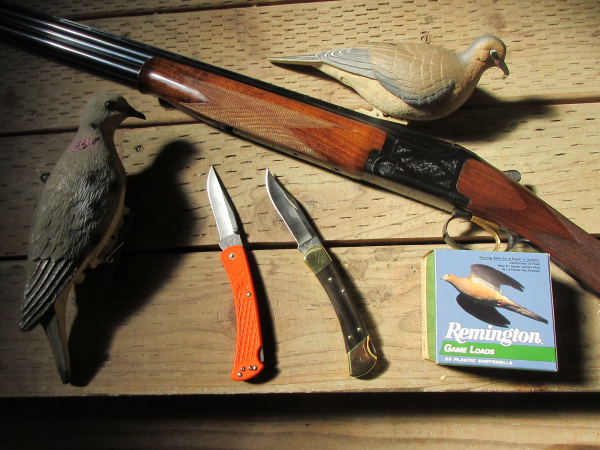
- Small fixed-blade or folding knife — breasting birds in the field takes seconds with the right edge. Our sister site’s pick for a compact fixed-blade EDC knife handles dove duty perfectly.
- License + HIP certification — doves are migratory game birds. HIP is mandatory in every state with a season.
- Clay targets — the cheapest insurance in this list. More below.
Shotgun and choke: swing beats power
A dove crossing at 35 mph gives you about two seconds. The right dove gun is the one that mounts fast and swings smooth, which is why so many limits fall to 20-gauges and even 28s. If you are shopping for a dedicated dove gun this summer, online retailers such as GunPrime list plenty of field-grade autoloaders under $700.
Keep the choke open. Improved cylinder covers 90 percent of opening-day shots inside 30 yards. Screw in modified for late-season birds that trade high between roosts. Pattern both on paper the same way we lay out the shotgun patterning checklist for turkey season, just at 25 to 30 yards instead of 40.
Shells: buy double what you think you need
Most hunters average a bird for every five to seven shells. A 15-dove limit can burn through three boxes before the afternoon flight ends. Standard No. 7.5 or 8 target loads in one-ounce weights kill doves cleanly and pattern well from open chokes.
One regulation note: federal migratory-bird rules limit pump and semi-auto shotguns to three shells total. Keep the plug in. A game warden checks that before anything else.
| Scenario | Shot size | Choke | Typical range |
|---|---|---|---|
| Opening-day feed field | No. 8 | Improved cylinder | 15–30 yards |
| Waterhole afternoon | No. 7.5 | Improved cylinder | 20–35 yards |
| Late-season flight lines | No. 7.5 | Modified | 30–40 yards |
Comfort gear: the hunt is a sit, not a stalk
Dove hunting is hours of sitting punctuated by seconds of shooting. A low stool or swivel bucket saves your back and keeps you still. Shade matters more than camo pattern, so set up under a field-edge tree when you can. Freeze two water bottles the night before; they thaw into cold water by the afternoon flight.
September fields are still summer fields. Ticks and chiggers work field edges hard, and our ranked tick repellent picks for 2026 cover the permethrin treatments worth spraying on pants and boots the week before.
Decoys: one spinner changes everything
A spinning-wing decoy on a pole, set 20 yards out and a foot or two off the ground, pulls passing doves off flight lines better than any call or clip-on. Add a few static clip-on decoys to a nearby dead limb and you have built the only spread dove hunting requires. Run the spinner off the same rechargeable batteries you use for trail cameras.
The three shots to practice before September
Dove fields serve the same three presentations all day. Learn them on clays and the opener feels familiar instead of frantic:
- The crosser. The bread-and-butter dove shot. Swing through the bird, see daylight ahead of the beak, and keep the barrel moving after the trigger breaks. Stopping the swing is the number-one miss in every dove field in America.
- The incomer. Birds coming straight at the decoy spinner look easy and are not. Blot the bird with the muzzle, fire as it disappears, and resist the urge to lift your head.
- The going-away riser. A dove that flushes off the field climbs as it leaves. Paint up through the bird and shoot at the top edge.
Twenty-five clays per presentation, twice in August. That is the whole program, and it costs less than a single box of premium shells wasted on rusty swings.
What the full kit costs in 2026
Starting from a shotgun you already own, the rest of the dove hunting gear list comes in under $200. Shells run about $9 to $12 per box at mid-summer prices, so three boxes cost roughly $30. A swivel bucket runs $25 to $40. A spinning-wing dove decoy costs $40 to $70 with the pole. Clip-on decoys add $15 a half-dozen. A case of clays is about $15, and HIP certification is free to a few dollars depending on the state. The most expensive mistake is skipping the practice and paying for it in shells all season.
HIP registration: two minutes that keeps you legal
Doves are migratory game birds under federal law, so every state requires Harvest Information Program certification on top of a small-game or hunting license. It is free or nearly free and takes two minutes online. The USFWS HIP page explains the program, and your state licensing portal adds it at checkout. Texas, the biggest dove state in the country, walks through its requirements at TPWD’s migratory bird page.
Practice now: clays are the cheapest gear on this list
The gap between a 3-box day and a 1-box limit is 200 practice clays in August. Crossers and incomers, thrown low and fast, mimic doves better than high skeet presentations. Two range sessions rebuild the swing your hands forgot since January. If early teal season is on your September calendar too, the same practice pays twice.
Know your season structure before you buy a nonresident license
Most states split dove season into two or three segments, with the first running from September 1 into October and later splits reopening around holidays when birds push south. Daily limits sit at 15 birds in the majority of states, with possession limits at three times the daily number. Shooting hours typically open one half-hour before sunrise, though several states hold opening day to a noon start on public fields. None of that is trivia. A second-split trip in December uses the same gear list with a warmer jacket, so the equipment you buy in July earns its keep twice. Check your state’s current dates and zone maps before buying travel licenses, because zone lines move more often than hunters expect.
Dove hunting gear FAQ
What shot size is best for dove hunting?
No. 7.5 and No. 8 are the standard choices. No. 8 throws more pellets per ounce and shines on close opening-day birds, while No. 7.5 carries a little more energy for 35-yard crossers later in the season. One-ounce loads from either size kill doves cleanly.
What choke should I use for doves?
Improved cylinder is the default dove choke. It patterns wide enough to forgive imperfect leads inside 30 yards, where most dove shots happen. Switch to modified when pressured birds start trading higher and wider in the second half of the season.
Do I need a plug in my shotgun for dove hunting?
Yes. Federal migratory-bird regulations limit pumps and semi-autos to a three-shell capacity for doves, the same rule that governs waterfowl. Fixed-magazine guns that hold more than three must be plugged. Wardens check plugs on dove fields constantly.
Do I need HIP certification to hunt doves?
Yes, in every state with a dove season. Harvest Information Program certification is a free or low-cost add-on to your hunting license, completed online in about two minutes. It must be renewed each license year and carried with your license in the field.
How many shells should I bring on a dove hunt?
Three boxes per hunter per day is the working minimum. The national average runs five to seven shells per dove, and a 15-bird limit at that rate consumes 75 to 105 shells. Extra boxes ride home fine. Empty pockets on a hot flight do not.
The birds have not changed since your grandfather’s opener. The line at the ammo counter has. Buy the shells in July, break the clays in August, and September 1 takes care of itself.
More dove hunting on Popular Outdoorsman
- Dove hunting tips: scout, shoot and clean more birds
- Dove season 2026: dates, limits and where to go
Reader Favorites
- 5 folding hunting knives for every day use
- What Kind of Hunting Do You Do With a Shotgun?
- Safety Tips to Create Better a Hunting Experience for Everyone
- Hunting Gear List – Are You Making the Right Checklist?
- Important Whitetail Hunting Tips for Beginners
- Leupold LTO-Tracker – A Must Addition To Your Deer Hunting Gear Checklist
Field-to-table reference desk
From tag to table — official season dates for all 50 states, plus safe doneness temps for your harvest.
| Species | Archery | Firearm |
|---|---|---|
| Deer | Sep–Oct | Nov |
| Elk | Sep | Oct–Nov |
| Turkey | — | Apr–May |
All 50 state wildlife agencies, plus how seasons, tags and licenses work.
Find your state → Network| Doneness | Target |
|---|---|
| Rare | 125–130°F |
| Medium-rare | 130–135°F |
| Well-done | 160°F+ |
Safe pull temps for venison and steak, from Popular BBQ.
View full chart →