Concealed Carry Reciprocity: A Hunter’s & Traveler’s Guide
Last updated: July 22, 2026 · Originally published: July 24, 2026
Concealed Carry Reciprocity: A Hunter’s & Traveler’s Guide
For hunters, outdoorsmen, and travelers who legally carry a firearm, few topics create more confusion than concealed carry reciprocity. What is legal in your home state can become a serious criminal issue the moment you cross a state line. Laws change, reciprocity agreements shift, and the rules for non-residents are often different from those that apply to locals. Navigating this patchwork without reliable information is a common source of stress for law-abiding gun owners.
This guide is designed to give hunters and travelers a clear, practical understanding of reciprocity so they can plan trips with greater confidence.
What Concealed Carry Reciprocity Means
Concealed carry reciprocity is the recognition by one state of a concealed carry permit issued by another state. In simple terms, it answers the question: “Will my permit allow me to legally carry a concealed handgun in this state?”
Unlike a driver’s license, which is recognized nationwide, there is no single national standard for concealed carry permits. Each state decides for itself which out-of-state permits it will honor, under what conditions, and whether it distinguishes between resident and non-resident permits. Some states honor nearly every valid permit. Others honor only a limited list. A handful of states honor none at all.
Even when reciprocity exists, the permit holder must still follow the laws of the state they are currently in — including restrictions on where firearms may be carried, magazine capacity limits, and duty-to-inform rules.
Why Reciprocity Matters Most to Hunters and Travelers
Hunters and travelers regularly cross state lines for multi-day trips, hunting seasons, competitions, or family visits. A single road trip can take a person through three or four different legal environments in one day. A permit that is perfectly valid at home may offer no protection in the next state, turning a lawful carrier into someone who is technically committing a crime by simply possessing a loaded handgun in the wrong place.
For hunters, this issue is especially practical. Many travel to other states for deer, elk, or bird seasons and want the ability to carry for personal protection while in camp, traveling to and from the field, or stopping in towns along the way. Understanding reciprocity in advance prevents the difficult choice between leaving a firearm at home or risking a violation.
How to Check Reciprocity Before the Trip
The most important step any traveler can take is verifying current reciprocity information before leaving home. Laws and agreements change, sometimes with little public notice.
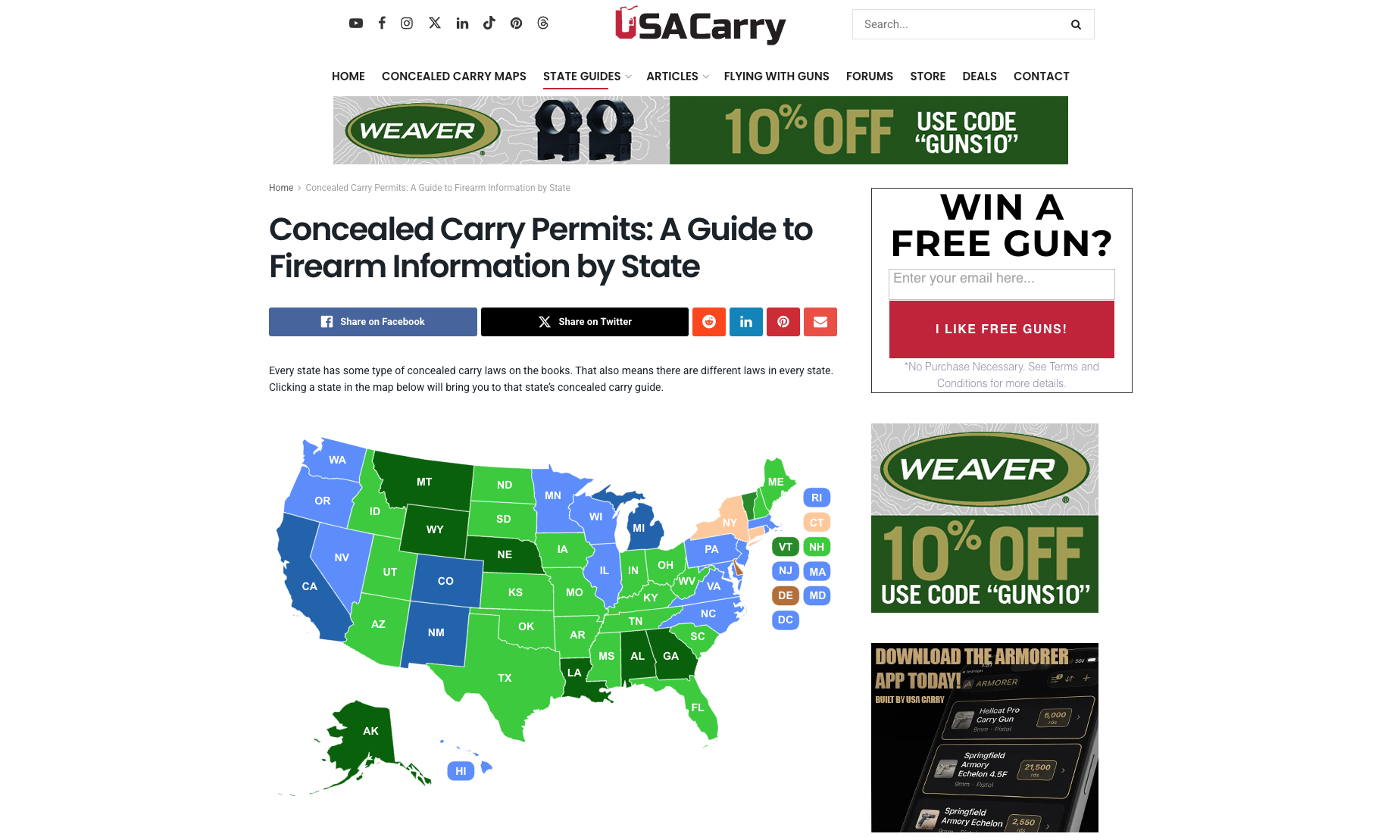
One of the longest-running and most widely used resources for this purpose is USA Carry. For years, USA Carry has maintained interactive reciprocity maps and state-by-state information that help permit holders quickly see where their specific permit is recognized. The site also covers related travel topics, including flying with firearms.
The same team behind USA Carry also developed the Armorer app, which is one of the prizes in the 100th Day of Silence grand-finale giveaway. Armorer is designed to give legally minded gun owners practical tools and information for responsible ownership and travel. Having both the long-standing reciprocity resources from USA Carry and the Armorer app available makes it easier for hunters and travelers to stay informed.
Always cross-check critical information with official state attorney general or state police sources when possible, especially right before a trip.
Common Reciprocity Mistakes to Avoid
- Assuming constitutional carry in your home state automatically allows you to carry without a permit in another state. Many constitutional carry states limit permitless carry to residents only.
- Believing reciprocity is always mutual. Just because State A honors State B’s permit does not mean State B honors State A’s.
- Failing to distinguish between resident and non-resident permits. Some states only honor resident permits from other states.
- Relying on outdated maps or screenshots from previous years.
- Ignoring location-specific restrictions even in states that honor your permit (schools, government buildings, private property with signage, etc.).
Quick Pre-Trip Carry Checklist
- Confirm your permit is current and not expired.
- Check the most recent reciprocity information for every state on your route and final destination.
- Verify whether the destination state honors resident versus non-resident permits.
- Review restricted locations and any magazine or ammunition restrictions in those states.
- If flying, review airline and TSA firearm transportation rules in advance.
- Carry a printed or digital copy of your permit and any supporting documentation.
- Know the duty-to-inform rules (if any) in the states you will visit.
Keep Your Records Straight
Good record-keeping reduces stress and helps demonstrate that you made a good-faith effort to follow the law. Keep digital or physical copies of:
- Your current concealed carry permit
- Any non-resident permits you hold
- Screenshots or printouts of reciprocity information checked before the trip (with dates)
- Relevant state statutes or official guidance when available
These records are not a substitute for following the law, but they can be useful if questions ever arise.
Concealed carry reciprocity does not have to be a source of constant uncertainty. With reliable resources such as those provided by USA Carry, and tools like the Armorer app, hunters and travelers can plan trips more confidently and stay on the right side of the law. As always, this article is for educational purposes only and is not legal advice. Laws change, and the final responsibility for compliance rests with the individual.
Frequently asked questions
What is concealed carry reciprocity?
It is when one state recognizes a concealed carry permit issued by another state. There is no national standard, so recognition varies from state to state.
Does my permit work in every state?
No. Some states honor most permits, some honor only a few, and some honor none. Always check before you travel.
How do I check where my permit is honored?
Use an interactive reciprocity map, such as the free concealed carry reciprocity map from USA Carry, and check both your destination and every state on your route.
Do resident and non-resident permits have the same reciprocity?
Not always. Some states honor one and not the other, which is why many travelers hold a non-resident permit from a widely recognized state.
Is carrying a concealed handgun the same as transporting a hunting rifle?
No. Concealed-carry law and long-gun transport law are separate and can differ at the state line, so a hunter often has two legal questions to answer for the same trip.
How often do reciprocity rules change?
Regularly. States update agreements and laws, so verify with a current map before every trip rather than relying on old information.
Related reading
- USA Carry — concealed carry resources and reciprocity map
- Armorer Pro: the round-count app every hunter should run
- Dove hunting gear 2026: the essentials to buy first
- Subsonic ammo for suppressors: what it is and the best loads
- Silencer Central’s 100 Days of Silence finale — enter the free giveaway
This article references USA Carry and mentions the Armorer Pro membership included in Silencer Central’s 100 Days of Silence, a paid sponsorship between Silencer Central and Brand Avalanche Media, Inc. Always confirm current firearms laws with the relevant state before you travel; this article is informational and not legal advice.
Reader Favorites
Field-to-table reference desk
From tag to table — official season dates for all 50 states, plus safe doneness temps for your harvest.
| Species | Archery | Firearm |
|---|---|---|
| Deer | Sep–Oct | Nov |
| Elk | Sep | Oct–Nov |
| Turkey | — | Apr–May |
All 50 state wildlife agencies, plus how seasons, tags and licenses work.
Find your state → Network| Doneness | Target |
|---|---|
| Rare | 125–130°F |
| Medium-rare | 130–135°F |
| Well-done | 160°F+ |
Safe pull temps for venison and steak, from Popular BBQ.
View full chart →